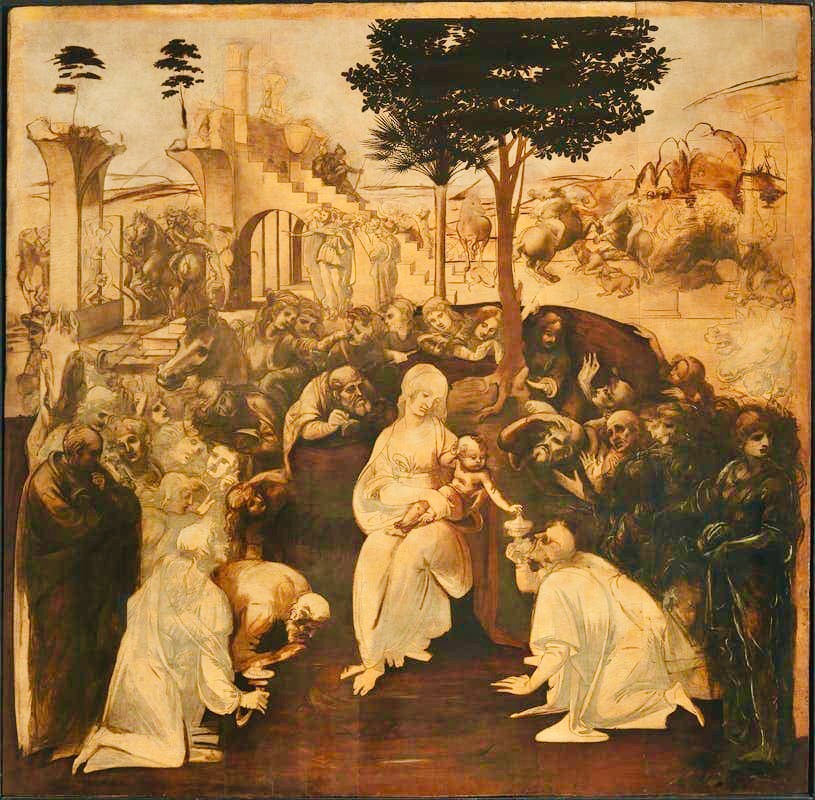
The Epiphany of the Lord granted the genius Leonardo da Vinci so many epiphanies that he could not finish the work (see Francesca Fiorani, 2016).
Da Vinci saw the Epiphany not as a single point in a night sky, but the physical manifestation of the divine light. The divine light of the Epiphany draws in and unites magi, kings, shepherds, poor bystanders, people and animals alike. Da Vinci drew in all his genius insights from optical science, but the Epiphany remained beyond his ability to fully render in painting.
This reflects upon the Mystery of the Epiphany, which requires Revelation, beyond the human wisdom of even the magi (Matthew 2:1-12).
Epiphany: an illuminating discovery, or revelation.
Saint Paul explains his epiphany – a gift of God’s grace, revealing the Mystery of our salvation in Christ,
“…to bring to light the plan of the Mystery hidden for ages in God, who created all things, so that through the church the manifold wisdom of God might now be made known to the rulers and authorities in the heavenly places. This was according to the eternal purpose that he has realized in Christ Jesus our Lord, in whom we have boldness and access with confidence through our faith in Him”
Ephesians 3:2-12
The Solemnity of the Epiphany is a celebration of our enlightenment in the Truth of our Salvation in Christ.
‘Arise, shine, your light has come, the glory of the Lord shines upon you!’ (Isaiah 60:1-6).
Our Evening Prayer antiphon highlights three scenes for the Epiphany, the manifestation of Jesus Christ as the Son of God sent for our salvation:
‘Three Mysteries mark this holy day:
today the star leads the Magi to the infant Christ (Matthew 2:1-12);
today water is changed into wine for the wedding feast (John 2:1-11);
today, Christ wills to be baptized by John in the river Jordan to bring us salvation (Mark 1:7-11).’
The gifts the magi bear further contribute to the Epiphany.
They seek a Godly king, offering kingly gold along with incense for worship.
They offer anointing myrrh, for Christ, the anointed one. Myrrh is used as a burial ointment, foreshadowing Christ’s passion and death, His Sacrifice for our salvation. Yet the myrrh was not needed for that; the tomb could not hold the Christ, and we have the revelation that through our Baptism, we have a share in Christ’s Resurrection unto true Life eternal (Luke 24; Romans 6).
The magi, seeking truth through the light of human wisdom, were open to hopeful signs in times of unrest (Benedict XVI, Jesus of Nazareth: The Infancy Narratives, Chapter IV).
They may have been familiar with a prophecy recorded before and beyond the Israel of the time of Christ’s coming into our world:
‘I see him, but not now, I behold him, but not nigh: a star shall come forth out of Jacob, and a sceptre shall rise out of Israel’ (Numbers 24:17).
They might have taken a surprising star in the heavens, as a sign of this new Jewish king who might bring peace not only to Israel but to their own situation. And so they set out in pilgrimage with their appropriate gifts.
Yet their human wisdom can only take them so far. They go to the obvious place, the place of the worldly king, in the palace of capital Jerusalem. From there, they need revelation (Matthew 2:1-12).
The prophets guide them.
The Wonderful Counselor, Mighty God, Everlasting Father, Prince of Peace, shall come from Bethlehem… He shall be great to the ends of the earth… He shall be our Peace (Isaiah 9:6-7; Micah 5).
Worldly King Herod was frightened by this Revelation, and all Jerusalem with him. Rather than hoping in this sign, this epiphany, of the heaven-sent Prince of Peace, they only feared confrontation with worldly powers.
The magi continued in hope. And the star preceded them, guiding them to the place of the newborn King. They bow down in worship, before the Light of Christ. As should we, in awe, in this Solemnity of the Epiphany.
For Christ seeks only to unite us in His heavenly peace, through His Church. Our Morning Prayer antiphon again reflects this beautiful Mystery:
‘Today the Bridegroom claims His bride, the Church, since Christ has washed her sins away in Jordan’s waters;
the Magi hasten with their gifts to the royal wedding; and
the wedding guests rejoice, for Christ has changed water into wine, alleluia.’
Pope Saint Gregory the Great (Homily on the Gospels 10) asks for our gifts to celebrate the Epiphany:
to pass on the shining gold, the light of Christ’s Wisdom, and
to offer our incense of prayer and adoration (Revelation 8:3-4),
in thanksgiving for His saving Sacrifice,
with the myrrh of our small daily sacrifices to the Lord (Matthew 39; Romans 12:1).