From the early saints in the Roman Canon, ‘Saint Agatha, Saint Lucy, Saint Agnes, Saint Cecilia, Saint Anastasia…’ Saint Lucy’s journey in Faith, commemorated in our Advent Season, began with a pilgrimage with and for healing for her hemorrhaging mother, to the tomb of Saint Agatha.
When Lucia and her mother reached Agatha’s tomb, they heard the preaching of the Gospel of the healing of the hemorrhaging woman (Matthew 9:20-22; Mark 5:25-34 and Luke 8:43-48).
Lucia’s young intercessory prayer to Agatha for her mother was met by a vision of Agatha, saying, your prayer to God suffices, your mother is already healed…
Lucia vows perpetual virginity to serve the Lord after this. She is found out by Roman authorities, but she is miraculously preserved from all the evils they try to inflict upon her. They try to move her; many soldiers cannot. They try to take her eyes; the light of her eyes does not fail. They try to burn her; the fire will not alight. They resort to the sword.
She remains venerated in the Roman Canon of the Mass we celebrate today.
These things were much less known to me, than to the devoted Americans and Latin Americans I was processing with in 2003, in honour of Our Lady of Guadalupe. In Belgium, we pilgrims from the Americas were small in number but rapturous even so. I could only imagine the fervor of thousands of pilgrims descending upon Mexico’s Basilica of Our Lady of Guadalupe.
Cistercian chapel at the American College in Leuven, Belgium in 2003.
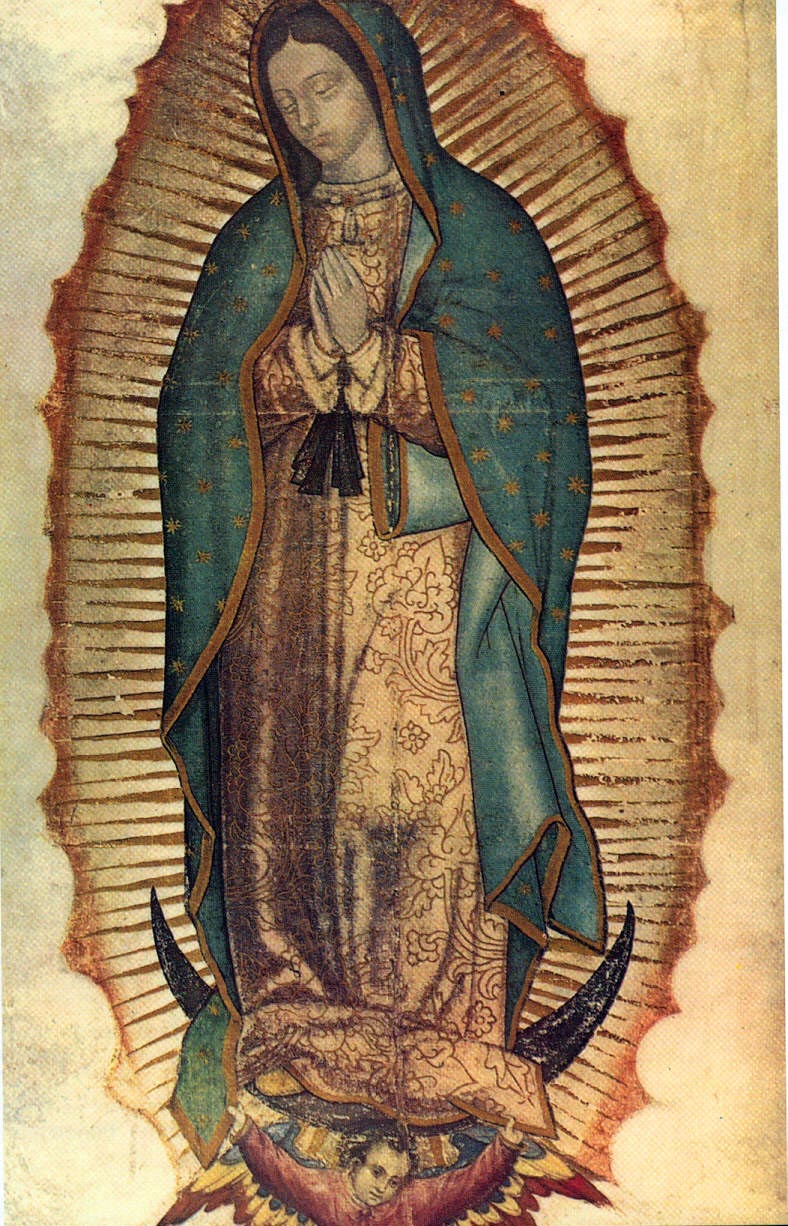
“A great portent appeared: a woman clothed with the sun, with the moon under her feet, and on her head a crown of twelve stars”
This image from the Book of Revelation matches the appearance of Our Lady of Gudalupe to Juan Diego in this feast day’s readings. Mary appeared to him emblazoned by stars, pregnant with divine presence, eclipsing the Aztec sun god with her own rays, and with the Aztec moon dragon serpent under her heel (Genesis 3:15; Bulzacchelli, 2011, p.49). Our Lady appeared with the good news of the true God, and she identified herself to Juan Diego with a title sounding like the prominent Marian Shrine of Guadalupe in Spanish, or “the one who crushes the head of the serpent” in Juan Diego’s language (Fr. William Saunders, 2004). This was an announcement of the victory of Christ the King come to give life abundantly (John 10:10). This overturned a culture of death in the Aztec practice of religious warfare and human sacrifice.
“Now the salvation and the power and the kingdom of our God, and the authority of His Messiah have come, for the accuser of our brothers has been thrown down, who accuses them day and night before our God.
The feast day readings do not offer a psalm in response to this Revelation. Rather, we have a reading from Judith, “blessed by the Most High God above all other women” for serving God’s Will (Judith 13). This is a precursor to Luke’s Gospel titling Mary as ‘blessed among women’ (Luke 1:39-47). Judith was recognized for serving God’s Will in a period of religious warfare in Israel’s history, but military strategy and violence could not bring about lasting peace. Mary and Elizabeth served God’s Will and brought about life. Christ’s Sacrifice brought about eternal life, and peace to people of good will.
Our society awaits and expects many things at this time. We prepare for the coming of our Messiah in this Advent Season, and for the Day of the Lord. Let us learn with her God’s Will for us, and like Juan Diego, make the good news of our salvation known to others.
Personal and immortal spiritual creatures of pure intellect and will, angels, meaning, messengers, with their whole being, are servants of God, always beholding His face, always hearkening to the voice of His Word (CCC §§ 328-330).
From infancy to death, human life is surrounded by the watchful care and intercession of their guardian angel. “Beside each believer stands an angel as protector and shepherd leading them to life.” Already here on earth the Christian life shares by faith in the blessed company of angels and men united in God.
‘Great indeed is the value of active life, but contemplation is better…whereas the works of the active life disappear with the body, the joys of contemplation wax greater with the end of this life’
– Gregory the Great, Morals in Job, 6.61
To aid our contemplation, Gregory the Great organized and contributed to the sacred music of the Church that bears his name, Gregorian Chant.
Saint Gregory Stained Glass at Saint Michael’s Basilica
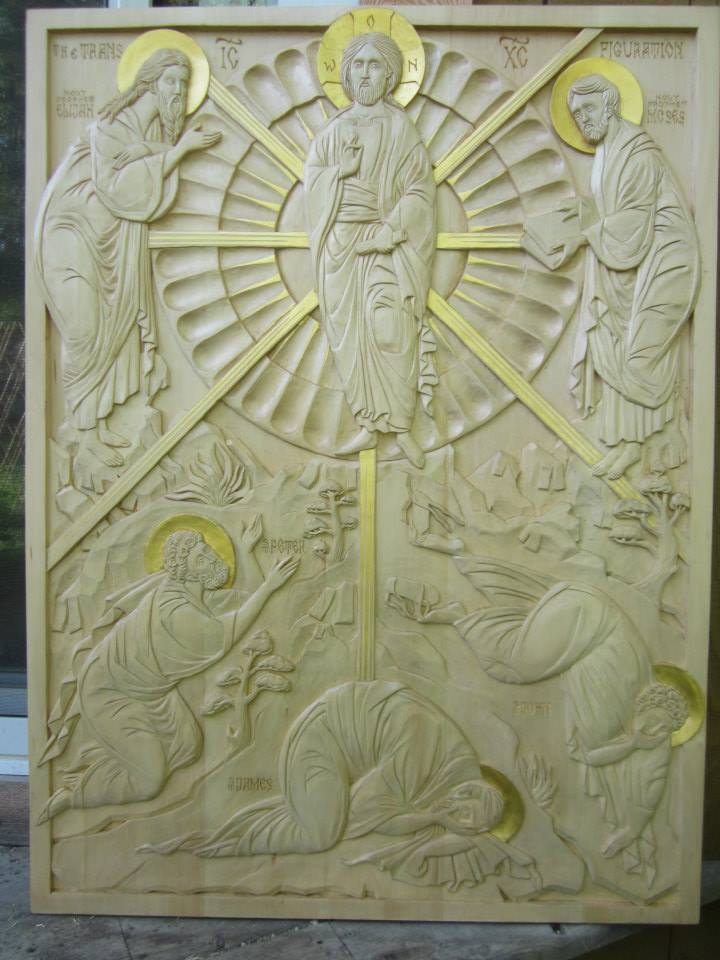
After this Transfiguration event, after the Passion, crucifixion, death, and glorious Resurrection of Jesus Christ from the dead, Peter, and James, and John, do testify to all these events.
Peter and the Apostles hand on not devised myth, but their own eyewitness accounts, unto their martyrdoms (2 Peter 1:16-19).
They give their testimony, in word and in writing for us, that they saw the Son of Man, the beloved Son of God, transfigured, glorified, in light.
The natural light of the sun is obscured by the shining cloud, the shekinah glory, of the Holy Spirit.
The voice of God the Father comes through this supernatural light, giving the testimony for His beloved Son, who fulfills the Law of Moses and all the prophecies of Elijah and all the prophets.
‘Listen to Him.’
Saint Peter writes, testifies, that we will do well to be attentive to this, as to a lamp shining in a dark place… as a morning star, rising in our hearts.
This is what the Transfiguration event can be for us now, a day star rising in our hearts.
Not long ago, we commemorated the great Solemnity of Pentecost, when Christ’s Church on earth began in earnest, in the power of the Holy Spirit, two millenia ago.
Since then, each Lord’s Day, we have prayed over the Gospel Word, from the calling of the Apostles. Peter, James, John, Andrew, all the apostles, handed on this Word of the Lord by their testimony. They handed on their testimony in unbroken lines of succession through the generations of bishops. As Saint Peter writes, the Gospel Word, and testimony, is not cleverly devised myth but simple Truth, explained to disciples, and openly sown in parables for all to hear, in these open, inviting, engaging stories, so that all may find in their fields the beautiful pearl of Truth of the Word of God.
Since Pentecost, our Christian mission handed down to us by Christ, through all apostles and disciples, is to go, make disciples of all, and teaching all of the Gospel Word, following on the Way of the Lord, until we enter into the Lord’s heavenly wedding banquet, when we will see Christ in all His power and glory over heaven and earth (see the Great Commission in Matthew 28).
The Way of the Lord for us in this life is to follow in virtue, in the beatitudes, pursuing what is true, honourable, just, pure, lovely, and gracious, as Saint Paul encourages (Philippians 4:8).
Our Lord reminds us, that with His Holy Spirit, He is with us always, to that end. Just as Jesus’ raiment became dazzling white, our Baptismal white robes of the saved in the Book of Revelation ( 7:9,13 19:14) will be our wedding garment for entry into the heavenly banquet (Matthew 22).
Sometimes, though, in this journey in faith, we may feel alone, struggling, this journey may become a slog. Our Lord is gentle, humble in heart, he offers to help us take up our yoke, to make our burden one of light, as in the light of the Transfiguration (Matthew 11).
Sometimes, though, we may feel in the dark, in darkness, so in need of our Lord’s promise of light.
So our Lord offers us this great example of a mountaintop experience, this peak experience. Mount Tabor is a 1,600 foot hike up an isolated rocky outcrop. As our late pope Benedict XVI observed, this place of ascent is ‘a liberation from the burden of everyday life, a breathing in of the pure air of creation and its beauty; it gives one an inner peak to stand on and an intuitive sense of the Creator’ (Benedict XVI, Jesus of Nazareth).
Our Lord gives this day star to rise in the hearts of His chosen apostles, to help them through what comes next in their journey. To get them through Gethsemene, the dark of the valley at the foot of the mount of olives. To again quote Benedict XVI: ‘It was here that Jesus experienced that final loneliness, the whole anguish of the human condition… Here He was to quake with the foreboding of His imminent death. Here He was kissed by the betrayer. Here He was abandoned by all the disciples… because He is the Son, He sees with total clarity the whole foul flood of evil, all the power of lies and pride, all the wiles and cruelty of the evil that masks itself as life yet constantly serves to destroy, debase, and crush life. All this He must take into Himself, so that it can be disarmed and defeated in Him ’ (Benedict XVI, Jesus of Nazareth – Holy Week).
Christ does this for us. He glorifies the bodily form He shares with all humanity, to remove the scandal of the Cross from the hearts of His disciples, showing the shining destiny to be fulfilled in the Resurrection (Preface of the Transfiguration).
Christ turns Gethsemene back into the Garden of eternal life.
Salome, mother of James and John, wife of Zebedee, is a follower of our Lord Jesus Christ, unto the foot of His Cross, unto His burial in the tomb (Mark 15:40-16:1).
She seeks salvation for her sons, that they may be at the Lord’s right and left hand in His Kingdom.
‘Can you drink the Chalice of My Blood, to be poured out for you and for many, for Salvation? Can You be Baptized with My Baptism?’
‘We can.’
James became the first sharer of Christ’s Chalice:
About that time Herod the king laid violent hands on some who belonged to the church. He killed James the brother of John with the sword, and when he saw that it pleased the Jewish authorities, he proceeded to arrest Peter also. This was during the days of Unleavened Bread…
To be at the Lord’s left and right hand, to drink the Chalice of the Lord, to become the friends of God (Communion antiphon), is to serve, as a witness to Life, with one’s life.
With Saint Paul (2 Corinthians 4:7-14), while we live, we witness to Christ with our life. ‘We believe, and so we speak, knowing that the one who raised the Lord Jesus will raise us also with Jesus and place us in His presence.’
‘The Gospels then tell us that the women, unlike the Twelve, did not abandon Jesus in the hour of his Passion (see Matthew 27: 56, 61; Mark 15:40). Among them, Mary Magdalene stands out in particular. Not only was she present at the Passion, but she was also the first witness and herald of the Risen One (see John 20:1, 11-18).
It was precisely to Mary Magdalene that Saint Thomas Aquinas reserved the special title, “Apostle of the Apostles” (apostolorum apostola), dedicating to her this beautiful comment: “Just as a woman had announced the words of death to the first man, so also a woman was the first to announce to the Apostles the words of life”‘ (Benedict XVI, General Audience 14 February 2007).
Mary Magdalene, Apostola Apostolorum (John 20:10-18), by Br. Emmaus O’Herlihy, OSB
Christ on the Cross – Stella Maris Church, Our Lady of Good Counsel Parish, Diocese of Saint John, NB
On the Cross, Christ’s head is bowed in reverence, offering His Grace in mercy, and compassion to His brothers and sisters, bringing us into a fraternity which the world’s isolating ‘equality’ cannot offer. Arms outstretched, that he might embrace us. Hands open, to enrich us. Hands, feet, nailed, that He may stay there with us and for us, He will not leave us. His side is open for us, to enter into His Church, Word, water, wine, given for us.
Saint Benedict’s name means blessing, and the cross of Saint Benedict brings blessings that curse evils.
The image of Saint Benedict has the Cross in his right hand and his rule for a way of life in his left hand.
A shattered cup with a serpent recalls a poisoned cup intended for Benedict shattering when he blessed the cup with the Sign of the Cross: ‘Crux s. patris Benedicti,’ ‘The Cross of our holy father Benedict.’
The raven similarly recalls the carrying away of a poisoned loaf of bread intended for Benedict.
Saint Benedict survived these attempts on his earthly life, to die peacefully with this brother monks in his Montecassino chapel after receiving Holy Communion.
‘Eius in obitu nostro praesentia muniamur!,’ ‘May we be strengthened by his presence in the hour of our death!’
The Cross of Saint Benedict also offers blessings, and blessings against curses, with the initials: Circled C S P B: Crux Sancti Patris Benedicti, the Cross of our holy father Benedict. C S S M L: Crux sacra sit mihi lux, May the holy cross be my light. N D S M D: Nunquam draco sit mihi dux, May the dragon never be my guide.
The Cross above all offers Christ’s PAX, Peace.
Around the edges of the medal, the initials of a prayer of exorcism:
V R S N S M V: Vade retro Satana! Nunquam suade mihi vana! Begone Satan! Never tempt me with your vanities!
S M Q L I V B: Sunt mala quae libas. Ipse venena bibas! What you offer me is evil. Drink the poison yourself!
‘On the evening of that day, the first day of the week…’ The Lord’s Day.
‘Where the disciples were in fear…’ (John 20).
‘ Jesus came and stood among them and said to them, “Peace be with you.” When He had said this, He showed them His hands and His side. Then the disciples rejoiced when they saw the Lord.’
His wounds remain for us, eternally, for our contemplation, from His once-for-all perfect Sacrifice, in our Saving Lord’s perfect love for us, for our salvation.
Thomas was not with them. ‘Unless I see the wounds I will never believe.’
The next Lord’s Day. ‘Peace be with you.’ ‘See my hands and my side.’ ‘Do not disbelieve, but believe.’
‘My Lord and my God.’
As with Saint Pius X we might pray with each elevation of the Blessed Sacrament of the Altar, the Lamb of God, standing, as though it had been slain (Revelation 5).
Thomas’ journey in faith is ours.
We recall Thomas asking: ‘Lord, we do not know where you are going. How can we know the way?’ (John 14:5). Our Lord explains: I AM the Way, the Truth and the Life. Following on the disciples’ way, Jesus goes to Lazarus, back to Jerusalem, to the place where He will be sacrificed, along the way of the Cross (John 11). ‘So Thomas said to his fellow disciples, “Let us also go, that we may die with him.”’
There may be courage in dying with, alongside, but it may be harder for Thomas, for us, to die after, not seeing…
Continuing in the Gospel: ‘Now Jesus did many other signs in the presence of the disciples, which are not written in this book; but these are written so that you may believe that Jesus is the Christ, the Son of God, and that by believing you may have life in His Name’ (John 20:30-31).
That we may know the Way, in Truth, to Life eternal, with our Lord and our God.