Register No. 4 compiled by Mr. Winslow lists all those Motor Vehicles licenced in New Brunswick from January 1, 1913 to May 14, 1913, when a total of 477 Motor Vehicles were registered in the short period of a little over four months with Licence Numbers ranging from 701 to 1178.
Not all 477 vehicles will be described in this chapter, but representative descriptions, comments and notes of interest on various makes will be outlined. A complete listing however, is in the Appendix.
More new names and makes were added to those in the previous Register, and Fords had at this time all but caught up with the McLaughlin-Buicks.
A total of 84 Fords were registered compared with 85 McLaughlin-Buicks, Russells, Reos and E-M-Fs were trying hard to catch up with 39, 31 and 25 registrations, respectively. Cadillac and Overland each registered 17.
Seventy-three different makes are listed in Register No. 4, and trucks were now really coming into their own.
One truck bearing Licence No. 727 was a Reo, Factory No. 604, and registered on January 9, 1913, by T. McAvity & Sons, Ltd., Saint John. It is described as a delivery car with express box. A transfer is recorded to Fred I. Keirstead, Apohaqui, July21, 1916, and is reported as Burned in May, 1915. A further notation states OK-1916, so possibly it was rebuilt and re-licenced then.
…
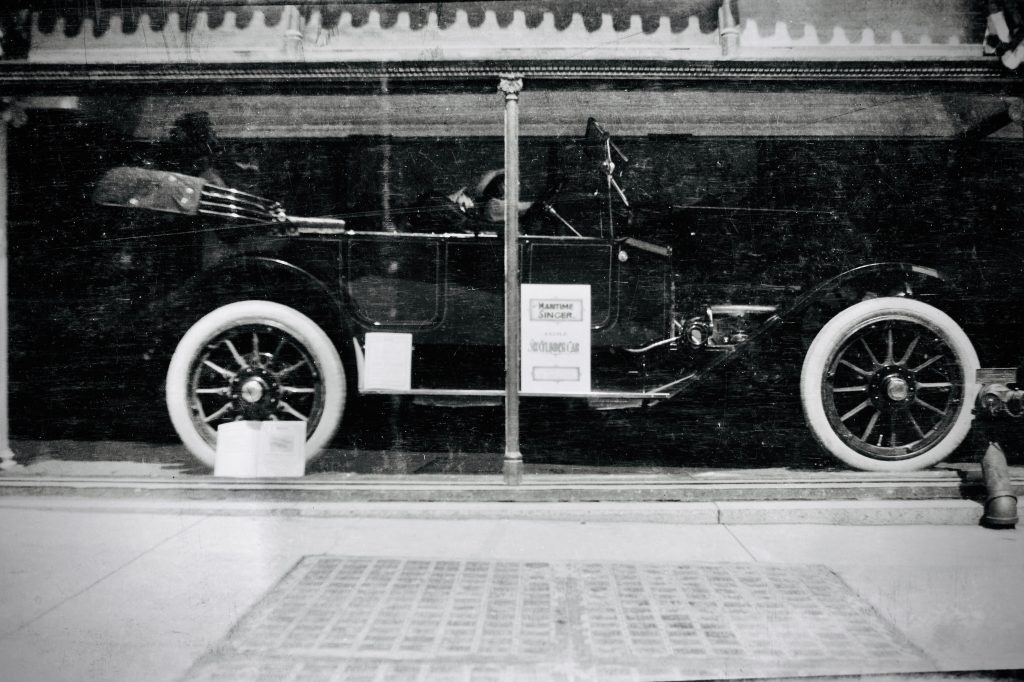
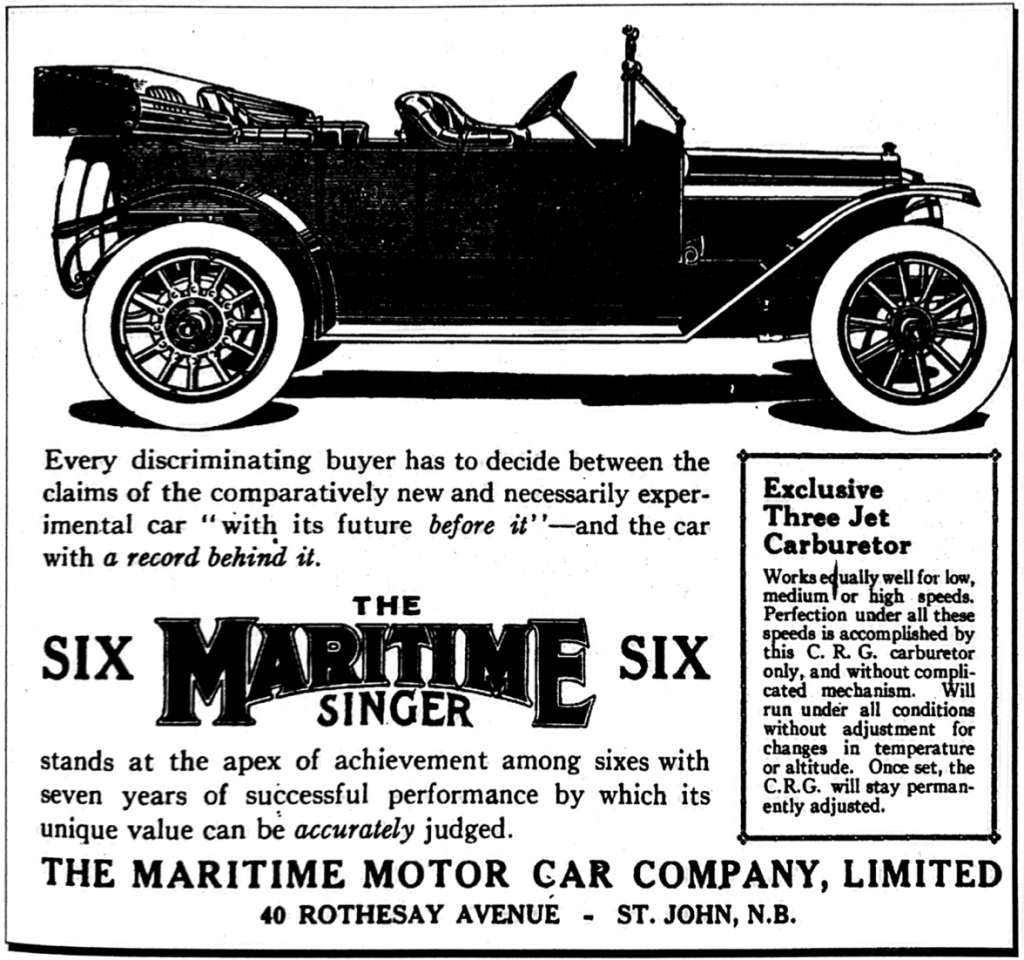
The last entry in this Register stirs considerable interest, especially among the members of the New Brunswick Antique Auto Club. The only automobile ever to have been built in New Brunswick, if one is to discount the Bricklin which was built in the late 1970s, was called a Maritime Singer Six, and a picture of it has been adopted as the Club’s symbol and adorns its letterheads, crests and plaques. This automobile, patterned after the American Palmer-Singer,and bearing Factory No. 453151 was a five-passenger touring car whose six-cylinder engine was rated at 38.4-horsepower.
This car was originally registered in the name of Thomas Bell, Pugsley Building, Saint John, on May 14, 1913, and was issued Licence No. 3262. It was transferred to Mr. J.H. Doody Jr., 16 Canterbury Street, Saint John.
On September 18, 1966, a group of 32 Antique Auto enthusiasts met in Harvey Station, N.B. to organize an Antique Auto Club, and at 4:30 PM on that chilly Sunday afternoon, the New Brunswick Antique Auto Club was born.
Interest in the Club soon mushroomed and by the time the year ended, close to one hundred persons had shown an interest in becoming Club members.
It was not too long before efforts were being made to adopt a Club symbol, and it was learned that an automobile was once built in Saint John in the early 1900s. Subsequent investigation revealed that an automobile called the Maritime Singer had in fact been assembled in a newly-built plant in Coldbrook on the eastern outskirts of Saint John around 1913, and a notice in the Horseless Carriage magazine dated April 13, 1912, advised of a merger between the Palmer-Singer Mfg. Company, New York City, and the Maritime Motor Co., Saint John, New Brunswick, Canada.
Mr. John A. Pugsley, a son of the Honourable William E. Pugsley,who for years was a Member of Parliament for Saint John, and later a Lieutenant-Governor of New Brunswick, had formed a partnership with two other Saint John gentlemen, Mr. Harold Miller and Mr. W. McLellan. The aim of this Company was apparently to purchase the components from Palmer-Singer and assemble them in Saint John.
They built their assembly plant in Coldbrook, and this building is still in existence, being used by the N.B. Department of Public Works [as noted at the time of writing Early Motoring in New Brunswick, in 1984].
The car was to be called the Maritimer or the Maritimer-Six. The venture did not succeed however, as it turned out that it cost about $10,000 to assemble a car that was intended to sell for $3,500.00. Information varies as to how many cars were assembled at Coldbrook, some saying only one, while others say two, three, or four. One thing seems certain, however; one does not exist today. It seems that the last to be seen was the one which belonged to Mr. John DeAngelus, and it is reported as having burned on the March Road just prior to World War I. All efforts to locate actual pictures or detailed information,or even actual parts of this Maritimer have failed, although some information was forthcoming as a result of newspaper and radio appeals.
Ms. Mabel L. Hamm, Rothesay, N.B. recalled that it was six-cylinder, open car with a canvas top and side curtains, and she actually had a ride in one. Her late husband, George P. Hamm, was apparently a very good friend of Jack Pugsley who enjoyed giving demonstration rides to his friends.
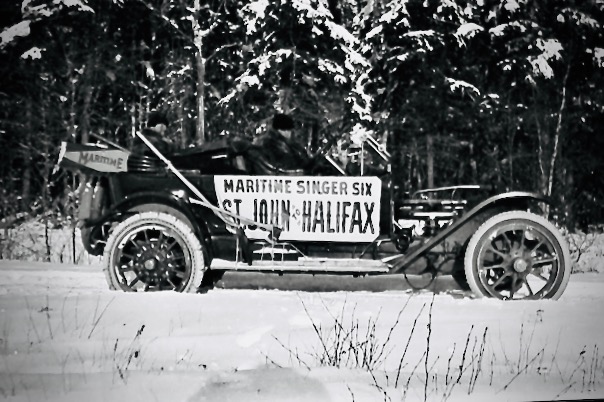
Mr. Edmund P. Fitzgerald, 197 Douglas Avenue, Saint John, stated that he clearly recalls a publicity stunt on New Years’ eve in 1912 when a Maritimer Six was driven from Saint John to Halifax. This was quite an accomplishment when one considers that this was in the middle of the winter with no roads to speak of.
Other valuable bits of information have been obtained from Mr. Charles Swanton, Saint John; Mr. Harold Ellis, Rothesay; Mr. Louis G. Knowles, Marblehead, Mass.; Frank Elkin, Osterville, Mass.; Mr. Walter Sherwood of Saint John; and Mr. Al. Zinicker of Sherwood, Oregon, U.S.A.
According to M. Zinicker, The Maritimer which was assembled in Saint John was the Palmer-Singer Brighton-Six manufactured in the United States by Palmer & Singer Mfg. Co. at Long Island, New York.
An advertisement and article appearing in Motor Age in October, 1912 reads: Luxury in every line. In announcing our models for 1913 we point with pride to the absence of mechanical changes. Cars that are properly designed and built do not have to be remodelled every year. We were the first to introduce a well-designed, high-grade 4 under $2000.00, and we were the first to offer a perfect six under $2500. Have you noticed the others following our example?
But what was this car like? What were its mechanical specifications? Here again Mr. Zinicker came through with a copy of an article which appeared in the October 1, 1913 edition of The Horseless Carriage and which is reprinted here:
The Palmer-Singer Line
The Palmer & Singer Mig. Co. of Long Island, N.Y. has developed a line of six-cylinder cars for the 1914 market. The line includes three distinct models, viz., the Six-Sixty, the Model L. Brighton Six, and the Model K Brighton Six.The cylinder dimensions and prices of the different models are as follows:
Six-Sixty: 4 7/8 x 5 1/2 – $3,525
Model L Brighton Six: 4 x 5 1/2 – $2,450
Model K Brighton Six: 4 x 5 – $2,295The prices apply to the cars with full equipment, including a self-starter.
The cylinders of the Six-Sixty are cast in pairs, while the cylinders of the other two motors are cast in threes.
The Horseless Carriage – October 1, 1913
In accordance with the usual practice, all of the engine bearing are plain and the engines are supported on the frame at four points.
On both of the Brighton Six models, the valve mechanism is enclosed, but this is not the case on the Six-Sixty.
The valve timing gears which are cut with helical teeth, are enclosed in a separate housing at the front of the crank case and operate in oil in a very quiet manner.
The cams are integral with the camshaft.
Engine lubrication is effected by means of splash from the crank case from which the oil flows to the gear pump which forces oil to the bearings.
An oil gauge is cast interal with the aluminum base chamber and a sight feed is secured to the dashboard to indicate to the driver that the oil is circulating freely.
Cooling is effected by means of a cellular radiator which is mounted on spherical trunnions, a construction on which the Palmer-Singer Co. owns a patent. The trunnions are ball-shaped and mounted in sockets, which arrangement protects the radiator against undue strains if the frame should become distorted.
The usual tie-rod between the radiator and the dash is not used, the radiator being steadied by means of the return connection from the top of the engine.
The water is circulated by a centrifugal pump. A large belt-driven fan, mounted behind the radiator, completes the cooling system.
On the Brighton Models, the power is transmitted to a multiple-disc clutch which is built into the flywheel and runs in oil. Directly back of the clutch is located a universal joint through which the power is transmitted to a small shaft connecting the main universal joint at the forward end of the propeller shaft. The latter is enclosed in an oil-tight torque head consisting of a spherical-headed sleeve floating on the torque head proper. A heavy cross-member of the frame carries the female member of this spherical joint, the latter being firmly bolted to the vertical flange of the cross-member. The gear shifting lever and the brake lever are so mounted that their axis produced passes through the center of the spherical joint. These levers are carried by a bracket secured to the side frame, the bracket being provided with the usual slotted quadrant and ratchet sector. All brake rods are adjustable.
Heavy radius rods run from the rear axle tubes to brackets on the frame side members.
The propeller shaft housing is carried on the frame at its forward and in this way takes care of the end as already explained, torque.
The transmission of the Brighton models is located on the rear axle and is of the three-speed type with reverse selective sliding gear. A bevel gear differential is used. The rear axle is of the floating type, with New Departure ball bearings. The driving shafts are provided with integral driving dogs which fit into corresponding slots on the rear hubs. The brake drums are I8 inches in diameter and are secured to the rear wheel hubs. Both sets of brakes act on these drums, one set being contracting and the other expanding.
Pressure fuel feed is used and the gasoline tank is located underneath the frame at the extreme rear. The necessary pressure is obtained from the exhaust gases which are conducted through a reducing valve mounted on the forward side of the dash. The gasoline tank has a capacity of 22 gallons and connects with the carburetor through a copper tube fastened in place by cleats. The muffler is located underneath the frame at the middle of the car to one side, symmetrical with the air tank on the opposite side. A cut-out is fitted and is operated by means of a foot-button located beside the starting button on the footboard.
The C.G.R. carburetor, which is of the multiple-jet type, is used on all three models,
though its details differ somewhat for the different cars. This carburetor has a concentric float chamber, and three individual jets surrounded by venturi tubes. These tubes are movable vertically by means of a cam operated by the foot throttle. The first jet has a needle adjustment for low speed, and is the only jet in use while running slowly. As soon as the throttle is opened a trifle more than is required for just keeping the engine running the second jet comes into action, and on further opening the throttle the third jet starts to supply mixture. This carburetor is water jacketed and copper tubing is used to carry water to and from it.
A dual system of ignition is employed, comprising an Eisemann magneto and a battery. The engine is controlled by spark and throttle levers on the steering wheel, as well as by a pedal interconnected with the throttle lever.
The front axle is an I-section drop forging. Semi-elliptic springs are used in front and three-quarter elliptic in the rear. All spring bolts are provided with grease cups and are case hardened.
Two Mondex shock absorbers on the rear axle are standard equipment.
The clutch of the Six-Sixty is also of the multiple-disc-in-oil type, and is enclosed in the flywheel. This model has the gear box amidships where it is carried on two substantial cross-members of the frame. It provides four forward speeds, of which the fourth is the direct drive, and one reverse. the spherical type of torque head is used, the drive being through a pair of close-coupled universal joints to a tubular housed propeller shaft. The rear axle is of the full-floating type with a bevel gear differential. Heavy radius rods are used to transmit the drive from the rear axle to the frame. The rear wheels are provided with two circles of bolts passing through the hub flange, spokes and brake drum, to provide adequate strength to take the great driving torque which the motor of this model is capable of developing.
The bodies are all of streamline effect. The standard colour is Brewster green, with light green striping. All metal trimmings are nickeled. The wheels are given a natural wood finish. The tire equipment consists of 35 x 4 1/2 inch United States tires on the Brighton models and 36 x 4 inch front and 36 x 5 inch rear United States tires on the Six-Sixty. Firestone quick detachable demountable rims are used. A sub-dash or instrument board is provided on which are mounted all gauges and dash fittings, including a Warner-Stewart speedometer, flush with the surface. the cars are furnished with either a two-passenger touring car body or a four or five passenger touring car body with extra deep cushions and a soft leather upholstery.
In accordance with common practice, the cars have clean running boards. Some of the items of equipment are a clear vision windshield, rear tire carriers, flush side lamps, number plate brackets, mohair top and boot. The Westinghouse electric lighting system is standard equipment, but an option is given on a Westinghouse electric starter and a compressed air starter manufactured by Palmer & Singer. The Westinghouse generator is driven from the pump shaft through a silent chain. It is located near the front end of the motor and is wired to a six-volt 120 Amere-hour battery carried under the front seat. All wiring is carried in conduits, and a 15-Ampere cartridge fuse is included in the negative side of the line and clipped to the forward side of the dash.
The air-starting system offered as an option to the electric starter comprises a Kellogg air pump which is connected through a clutch to the same shaft as the water pump. The air tank is suspended from the frame at one side.
As stated previously, all hopes of locating and restoring a Saint John-assembled Maritime Singer Six are dim indeed, but quite possibly someone knows of the existence of a Palmer-Singer, quite a few of which were imported during the period just prior to World War One, and some were registered and licenced in New Brunswick, notably around St. Andrews, Saint John, and Moncton.
Late in the winter of 1912, it was decided to publicize the Maritime-Singer by giving one of their cars a real run just before Christmas when the roads and driving conditions were at their worst. James Pullen, 14 Horsefield Street, Saint John, agreed to drive the Maritimer from Saint John to Halifax. The drive was successfully completed, but not without considerable difficulties. The road conditions at that time of the year proved to be the greatest obstacle.
An old print obtained from Mrs. Pullen, widow of the driver, shows Mr. Pullen at the controls with several willing hands giving a push to assist the Maritimer in negotiating one of the many steep, rutty, and partly frozen road surfaces. Chains, pries, logs, and lots of muscle power were the vogue, but the trip was successfully completed. Of such stuff are all Maritimers made of! “If it can’t be done we’ll do it!!!”
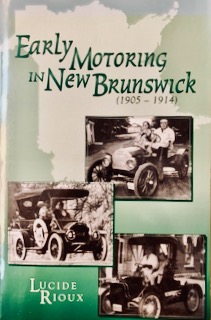
This excerpt was from pages 75-81 of Lucide Rioux’s Early Motoring in New Brunswick (1905-1914), originally published in 1984 and reprinted in 2003, ISBN 0-9689162-1-X .
CBC New Brunswick documented Brian Chisholm’s recounting of the Maritime Singer Six story (a monster car, weighing way more than any other car at the time, with 36″ wheels…), the Saint John to Halifax winter trip, and newly uncovered, centuries old photos. These add to the photos previously published in the Saint John Standard from December 31, 1913.
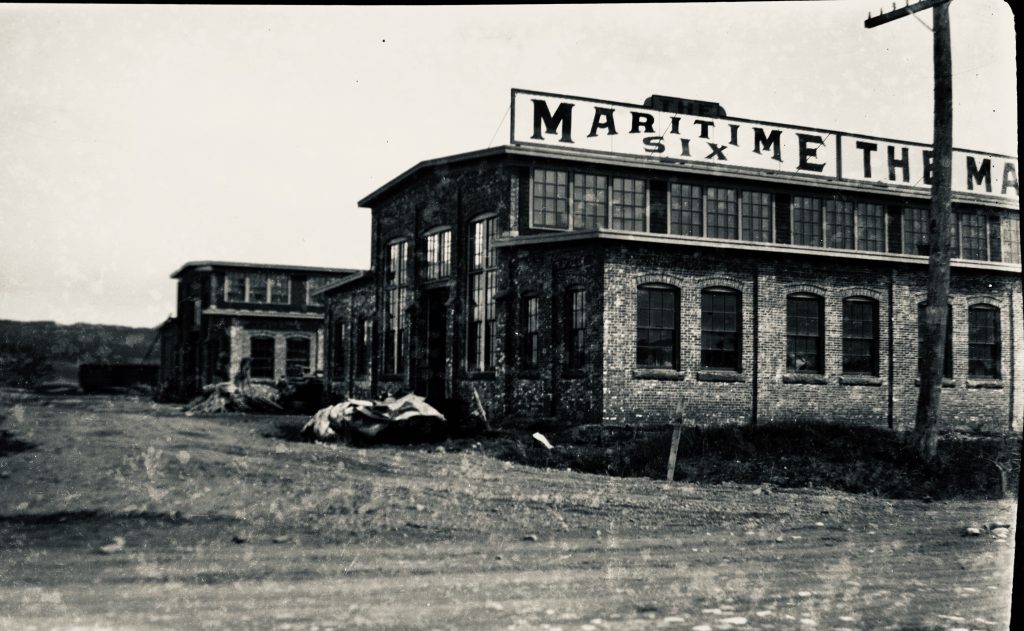
The original negatives of the recently uncovered photos of the Maritime Singer Six and its factory building are in the New Brunswick Provincial Archives (Ottie White collection).