• Bible Study Resources
    • Census
    • Links
      • The Word and Liturgy Links
      • Art Links
      • Sacred Music
      • Poetry Links
      • Sacrament of Matrimony Links
      • Catholic Education
      • Christian Legal Issues
      • Sacrament of Reconciliation Links
    • Prayer Cards
    • Starting a Schola
    • The Sacrament of Baptism
    • Funeral

Father David Rioux's Website

  • Memorial of Saint Elizabeth Ann Seton

    January 4th, 2023

    On this day in the Christmas Season, we may also observe the Memorial of Saint Elizabeth Ann Bayley Seton, Foundress of the Sisters of Charity of Saint Joseph.

    Saint Elizabeth Seton would seem to have many connections with Saint John, from the Loyalist days, to our present situation as we serve in Catholic Faith, Hope, and Charity.

    St. Elizabeth Ann Bayley Seton, Foundress, Sisters of Charity of St. Joseph’s

    Her husband’s family were British Loyalists during the revolutionary war, for which the Drinking with the Saints calendar honours Saint Seton with the Benedict Arnold cocktail… and Benedict Arnold also lived and did business in Saint John in those times.

    Saint Seton’s family business failed, the couple lost their home, and her husband was struck with tuberculosis. This prompted a move to Italy, through business contacts.

    William died, leaving Saint Seton a widow with five children at age 29.

    In Italy, a Catholic family opened their home to her. Their Catholic Faith consoled them, and her in her suffering.

    She opened her heart to the Catholic Faith, to receiving Christ who is truly present for us in the Eucharist.

    From her Communion antiphon, from the Gospel of John (6:51):
    I AM the living bread from heaven, says the Lord. Whoever eats this bread will live forever; the bread I shall give is My flesh for the life of the world.

    O taste and see how gracious the Lord is; blessed are they who take refuge in Him (Psalm 34).

    Saint Seton opened her heart to Mary, seeing her as near to us, and tender as a mother for us, while yet being the very Mother of God, as we just celebrated.

    She returned home, and entered her new home in the Catholic Church.

    From her memorial Antiphon, from Proverbs 14:
    Behold a wise woman who has built her house.
    She feared the Lord and walked in the right path
    .

    Saint Seton tried teaching, to provide for her children. The local community would not support a school with Catholic teaching.

    By the Grace of God, a Maryland community of Daughters of Charity of Saint Vincent de Paul formed, a community of service in education, religious, and cultural formation for the poor. Saint Seton was among the first to take her vows with this Faith community.

    Our businesses, other businesses, any solely human institutions that we may rely upon, fail. A family of Faith, a Faithful community, Christ’s one, holy, Catholic and Apostolic Church, the Grace of God, does not fail us.

    Saint Seton went on to found the Sisters of Charity of Saint Joseph, the first congregation of religious sisters in the United States.
    “Mother Seton” became the first woman born in New England to be canonized a Saint.

    She is sainted for seeking God in the simplicity of her heart, caring for her family, and caring for neighbour. This is simple, earnest, human, life.

    Again from her memorial Antiphon, from Psalm 27:
    One thing I have asked of the Lord, this will I seek after, that I may dwell in the house of the Lord all the days of my life.

    Here in Saint John, the long service of our Sisters of Charity of the Immaculate Conception built our schools and hospitals and cared for the poor.
    Our Saint Vincent de Paul mission of outreach for the poor continues.

    Saint Seton would be familiar with the lack of support for true Catholic education in liberal arts today. We pray for the mission of our small Catholic schools, like the Divine Mercy Catholic School here in Saint John.

    Saint Seton’s advice for us here and now in Saint John, for our families in faith: “be children of the Church.”

    From our reading of the First Letter of John (3:7-10), let us be righteous children of God, caring for our neighbour. Let us not be deceived in this world.

    God calls us, His children, each of us, by name (Gospel of John 1:35-42).
    God is who we truly seek. We are called to life, to faith, to our vocation in life, serving God’s Loving plan for us, unto true life eternal.

    Let us pray for Saint Seton’s intercession, that we seek out God’s Grace in our lives, for our families in faith, for our neighbour in need, for our Faith community, that we be children of the Church, and that we seek to dwell in the house of the Lord all the days of our lives.

    Let us share Saint Seton’s Faith in the Eucharist, the Body, Blood, Soul, and Divinity of our Lord and Saviour, Jesus Christ, as we prepare to “Behold, the Lamb of God” (John 1:36).

  • ‘I am Gabriel, I stand in the presence of God, and I have been sent to bring good news’ (Luke 1:5-25)

    December 19th, 2022

    The Gospel of this day announces the coming of John the Baptist who will ‘make ready a people prepared for the Lord’ ( Luke 1:17). This is what we are called to do in this Advent Season, to prepare for the Day of the Lord (2 Peter 3:10) and to commemorate Emmanuel, Christ’s coming to be with us in the Nativity of the Lord (Matthew 1:23).

    During Advent, we reflect on the two Annunciations in the Gospels: the Angel Gabriel’s Annunciation of John the Baptist to Zechariah and Elizabeth in their old age (Luke 1:5-25), and the Angel Gabriel’s Annunciation of Jesus, Son of God, to the young woman (Isaiah 7:10-14), the Blessed Virgin Mary (Luke 1:26-38).

    Annuncio dell’angelo a San Zaccaria, Domenico Ghirlandaio

    In both Annunciation accounts, the same Messenger Gabriel appears, both Zechariah and the Virgin Mary are troubled, and both are told, ‘do not be afraid’ (Luke 1:13; Luke 1:30).

    Mary questions how the annunciation will be (Luke 1:34).
    Mary receives her overpowering answer. Full of Grace, Mary trusts, and sets out with haste to visit Elizabeth (Luke 1:38-40).
    Zechariah ‘did not believe’ the Angel Gabriel. He is struck dumb for the duration of Elizabeth’s pregnancy (Luke 1:20). Zechariah’s grace was time in contemplative silence, to fully consider God’s gift and plan.

    These are the only two Annunciation accounts in the Gospels, announcing Christ our Saviour and His messenger, John the Baptist.

    There are more annunciations in the Old Testament (see Robert Alter, the Case of the Annunciation Type-Scene). 
    We can start in the beginning (Matthew 1:1) with our Father in Faith, Abraham, with the annunciation of Isaac to Sarah (Genesis 18:9-15); Jacob and Esau to Isaac (Gen 25:19–26); and children for Jacob and Rachel (Genesis 30). Hannah prayed to the Lord for the gift of Samuel, born to her and her husband Elkanah (1 Samuel 1).

    The annunciation of Samson to Manoah and his wife (Judges 13:2-25) is a different case in the Old Testament.
    There are similarities to Zechariah’s experience.
    The Angel Gabriel says that John the Baptist is never to drink wine or strong spirits (Luke 1:15).
    The Angel of the Lord says that Samson is to be a nazirite (Numbers 6:5), set apart for the Lord, from birth (Judges 13:4-5).
    Samson is to have no wine or strong drink, nothing unclean, and no razor is to touch his head.

    Zechariah questioned the angel and was struck dumb.
    Samson’s father Manoah was dumbstruck.

    He prayed to the angel to clarify the already very precise instructions.
    He didn’t even quite believe in the angel. He offered to host a meal to test the angel.
    The angel advised offering a sacrifice to the Lord, before spectacularly ascending to heaven along with the flame of that sacrifice.
    Then Manoah worried over being struck down for having seen something of God.

    We can be thankful Jesus had his trusting Mother and a better example of a human father in Saint Joseph.
    Zechariah questioned and was given time to think.
    Manoah’s example was a questionable start for Samson’s life.
    In the annunciation of Samson, Samson shall only begin to save Israel (Judges 13:5).
    Samson violates his vows, fails as a Judge, and only prefigures Christ in his end, arms outstretched in a cross, in a violent death (Judges 16:31).

    John the Baptist proclaims Christ (Matthew 3:1-11).
    Christ saves people from their sins (Matthew 1:21).

    John the Baptist saves us from our old ways, offering a baptism of repentance.
    This is a new year, let us begin anew in Christ.
    Let us not fall into the trap of our old ways, breaking our promises as Samson did.
    Let us renew our Baptismal promises, and keep them.

    O Root of Jesse’s stem,
    sign of God’s love for all his people:
    come to save us without delay!

  • Eucharistic Adoration

    December 15th, 2022

    Solemn adoration of the Most Blessed Sacrament of the Altar gathers with the O Salutaris hostia, one of the chanted prayers composed by Saint Thomas Aquinas for the Solemnity of the Most Holy Body and Blood of Christ:

    ‘O Priest and Victim, Lord of Life, open wide the gate of heaven to us below… our foes press on from every side; thine aid supply, thy strength bestow… To Father, Son, and Spirit blest, one only God, be ceaseless praise! O grant us endless length of days in heaven, our home, our true native land, with Thee…‘

    We kneel as the Blessed Sacrament is set into the monstrance on the altar.

    The monstrance, or ostensorium, is a beautiful vessel designed to ‘show,’ the meaning of both of those terms. The monstrance elevates the Blessed Sacrament, as it is elevated over the altar for consecration during the Eucharist.

    The altar is Christ, an alter Christus. The altar is dedicated, anointed with sacred chrism, incensed to signify Christ’s Sacrifice for our salvation, set with relics of the Saints who offered their lives in dedication to the Word of God. ‘Christ is the One anointed by the Father with the Holy Spirit, making Him “High Priest, who on the altar of His Body, would offer the sacrifice of His Life for the salvation of all”‘ (Catechism of the Catholic Church §1383).

    The Blessed Sacrament exposed in the monstrance is in the form of a corona, a circle, etched with a cross. The circular figure symbolizes infinity, as infinite as Christ’s self-sacrificial Love for us. The cross stretching across this symbol of infinity represents eternity, the eternal Cross of the one perfect Sacrifice Christ offers for all.

    We adore Christ in the Most Blessed Sacrament.
    God shares His divine Life with us.
    How can we not adore, to prepare ourselves, to make ourselves holy by gazing on Goodness, to pray that we may enter into and finally see the glory of our Lord Jesus Christ (2 Thessalonians 2:14).

    Christ Blessing – Jonathan Pageau

    At the close of adoration, the celebrant will approach the altar wearing a cope and a humeral veil. The cope, or cape, is used for Solemn prayer. The humeral veil is a vestment to separate oneself from the act of Blessing with the Blessed Sacrament. It is not the celebrant blessing us; it is Christ Himself, in the Most Blessed Sacrament, giving us His Blessing.
    We sing the Tantum ergo, down in adoration falling, bowing to Christ, the source of Grace.

    We may offer incense, like the saints in the book of Revelation (8:3-4). Incense is an aromatic tree resin, offered as a burnt offering from the time of Moses and Aaron (Exodus 30:7-8) to the prophet Malachi (1:11). We recall that the magi offered incense as a gift for Jesus (Matthew 2).

    The ritual concludes with the litany of the Divine Praises.
    We revere our God – Father, Son, and Holy Spirit – along with our Blessed Mother, Saint Joseph her most chaste spouse, and we again praise God in His angels and in His saints. We may sing Holy God, we praise thy Name.

    We may always come into the church and draw close to the real presence of our Saviour in the Tabernacle, under the glow of the sanctuary lamp (SC§66). The door of the Tabernacle, or the locked door of the upper room, cannot separate us from Christ. The exposition of the Blessed Sacrament for adoration is for our benefit, for us to focus our senses on, for us to be more present to Christ. “The act of adoration outside Mass prolongs and intensifies all that takes place during the liturgical celebration itself” (SC§66).

    Adoremus guide for Eucharistic Exposition, Adoration, and Benediction

  • Let me hear what God the Lord will speak, for he will speak peace to his people (Psalm 85)

    December 14th, 2022

    This Advent season is of expectant anticipation.

    Yet we must expect the Lord, no other (Isaiah 45).

    If we become caught in our own anticipations, we may become anxious, blinded, deafened, crippled in even our best intentions.

    Saint John the Baptist preaches repentance, out of concern for the coming wrath, the burning of chaff in fire (Luke 3:17).

    This will come. Yet here and now, the Lord comes to heal us, restore our senses, and set us back on the Way in Truth to Life eternal (Luke 7:19-23).

    If we expect and anticipate our Lord, and not some other, when we give up our own anticipations and apprehensions and fixations, our Lord will give us His peace (John of the Cross, Ascent of Mount Carmel, Chapter III).

    Saint John of the Cross

    Let us expect and anticipate and pray for the coming of the Lord, and the coming of the Kingdom of God, that our Saviour offers us in His Blessing (Luke 7:23).

    “Turn to me and be saved, all the ends of the earth! For I am God, and there is no other. By myself I have sworn, from my mouth has gone forth in righteousness a word that shall not return… To me every knee shall bow, every tongue shall swear…” (Isaiah 45:22-23).

    “Blessed is anyone who takes no offence at Me” (Luke 7:23).

    In our prayer, in our expectant anticipation in this Advent Season, ‘let us hear what God the Lord will speak, for He will speak peace to His people’ (Psalm 85).

  • ‘Trust in the Lord; the lofty city He lays low, the foot tramples it, the feet of the poor, the steps of the needy…’ Isaiah 26:1-6

    November 30th, 2022

    This Advent Season is a four week retreat to free ourselves from the distractions of this world, in between the Incarnation of Emmanuel, God-with-us, and the final coming of Christ the King in eternal glory that we look forward to. We have four weeks of Advent candles to meditate on the Lord’s Peace, Hope, Joy, and Charity. We meditate to deepen our trust in the Lord Hope and our Saviour.

    The Prophet (Isaiah 26:1-6) reassures us to ‘trust in the Lord forever, for in the Lord God you have an everlasting rock. The Lord has brought low the inhabitants of the height; the lofty city he lays low. He lays it low to the ground, casts it to the dust. The foot tramples it, the feet of the poor, the steps of the needy.’

    If we build our trust on the firm foundation of the Lord’s Word, the Gospel Truth, we will not fall, but we will ‘stand, lift up our heads, as our redemption will draw near (Matthew 7:24-27; Luke 21:28).

    From our Psalm (118), ‘O give thanks to the Lord, for He is good; His steadfast love endures forever! It is better to take refuge in the Lord than to put confidence in mortals. It is better to take refuge in the Lord than to put confidence in princes.’

  • ‘Andrew told his brother: we have found the Messiah, the Christ. He brought him to Jesus’ (John 1:42)

    November 30th, 2022

    The memorial of Saint Andrew the Apostle recalls for us the very meaning of the word apostle, ‘one who is sent.’  Andrew is prepared.  Andrew has an utmost longing for the coming of the Messiah. He shares in Israel’s yearning for the coming of Christ our Saviour, which we relive in this Advent Season.  

    Andrew is a disciple of John the Baptist, Christ’s forerunner.  Andrew hears John’s witness, behold the Lamb of God, behold the Son of God (John 1:40). In turn, Andrew becomes the first called among the disciples.  Andrew prepares his brother Simon Peter.  

    In the the words of the Gospel of John (1:42), ‘Andrew told his brother: we have found the Messiah, the Christ. He brought him to Jesus’ (John 1:42)

    In today’s Gospel, the brothers had prepared each other to hear the Lord’s call to serve, as we should in this Advent Season.

    From our responsory, ‘as soon as Andrew heard the Lord preaching, he left the nets which were his livelihood and way of life, and followed the Lord who gives eternal life.’

    When we realize that Jesus Christ truly is our Lord and Saviour who offers the ultimate meaning of our life and of our death, all else must be ordered to following Christ. 

    The apostles show us how. 

    Our Psalm (19) gives us glimpses of the realization of the glory of the Lord, and the calling of an apostle: 
    The heavens tell God’s glory, and His handiwork sky declares.
    Day to day breathes utterance and night to night pronounces knowledge…
    The Lord’s teaching is perfect, restoring to life…

    And so, 

    Through all the earth their voice goes out, to the world’s edge, their words.
    Let my utterances be pleasing and my heart’s stirring before You, Lord, my rock and redeemer.

    God’s glory calls us to yearn for our Saviour. 

    Yet our realization, our conviction of faith must be matched by our outward confession of faith, our witness to the saving power of Christ. Our witness requires us to respond with all of our heart, soul, mind… and voice.  

    Like Andrew, we must bring others to Jesus.  

    Saint Paul (Romans 10:9-18) tells us why.  ‘ If we do confess with our voice, and believe in our heart that God raised Him from the dead, we will be saved.’

    Baptized and united in Christ, it is for us to be raised from the dead in a resurrection like His, by the glory of God the Father, so that we along with our faithful departed may walk in newness of true life eternal.  

    ‘Everyone who calls on the name of the Lord will be saved.’

    Yet  ‘faith comes from what is heard,’ and so few today hear the true message of Jesus Christ.

    ‘How beautiful are the feet of those who bring the good news!’
    Let us bring the good news.

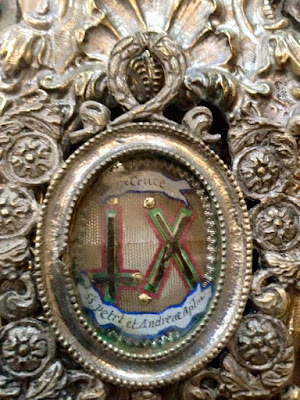
    Reliquary containing Saint Andrew’s Cross in the form of an X, and Saint Peter’s cross, upended for humility so as not to aspire to a Crucifixion like Christ’s
  • ‘O House of Jacob, come, let us walk in the light of the LORD’ (Isaiah 2:1-5)

    November 27th, 2022

    From Pentecost Sunday to the Solemnity of Christ the King, we are formed and sent forth in the Holy Spirit. We witness to the Gospel Truth with our very lives, in our homes, in our work, to all people of good will. Through our witness, we lead people to seek the kingdom of heaven, and to build up the kingdom of heaven in the beatitudes, in our present age. By this, we make ourselves ready and prepared for the last things, to welcome the Day of the Lord, when Christ the King comes in final glory.

    This Advent Season does not break from this journey in faith, but rather gives us a directed time of preparation, in a sort of guided retreat over four weeks. Our Gospel Word recalls Israel’s yearning for the virgin to be with child (Isaiah 7:14). We await again the only-begotten Son of God, born from before all ages, yet born unto us, Emmanuel, God-with-us and for us, to save our souls and redeem all His Creation.

    Advent, from ad-venire, means ‘to come to,’ expressing Israel’s yearning for the people to finally come, to climb the LORD’s mountain, to be instructed in His Way, to walk in the light of the LORD (Isaiah 2:1-5).

    This is a reflective and penitential time for us to prepare, before the great Solemnity of Christmas.
    We drape our liturgies in penitential colours, and we decorate modestly.
    We mark the time we have to prepare with four weeks of Advent candles, Advent calendars, and, in the octave before Christmas, the O Antiphons – O Sacred Lord, O Radiant Dawn, O Come Emmanuel.
    We refrain from the singing of the Gloria until Christmas, until Luke’s Gospel shepherds sing the Gloria in their annunciation of the Nativity of Our Lord.

    Annunciation to the Shepherds, Master of the Houghton Miniatures

    The penitential character of this Advent Season, this retreat, helps us to make our hearts ready to welcome our Christ anew (Antiphon, Evening Prayer, first Sunday of Advent).

    Our Gospel message tells of the consequences of not being ready and awake (Matthew 24:37-44).
    Saint Paul offers the advice we need in this time (Romans 13:11-14; Titus 2:12-13):
    ‘God our Saviour has appeared and instructs us to put aside impiety and worldly passions, to live temperately and uprightly in this present age, waiting patiently for the joyful hope, the appearance of the glory of our Great God and Saviour, Jesus Christ.’

    In keeping with this season of anticipation and longing for peace, we may humbly offer others the peace from our Psalm (122):
    ‘for the sake of our relatives and friends, I will say, peace be within you, for the sake of the house of the Lord our God, I will seek your good.’

    This Advent Season is an in-between time of preparation, having us recall our Lord’s first coming in swaddling clothes in the manger, to gently invite and persuade us into His plan of Love for us.
    His Passion, Resurrection from the dead, Ascension into heaven, and commission to mission for us, is all for love of us.

    Saint Cyril of Jerusalem prays over our Lord’s Second Coming,
    ‘clothed in light, gloriously escorted by an army of angels… The Saviour will not come to be judged again – but to judge those by whom He was judged. This time, whether we like it or not, we will be subjects of His Kingdom by necessity. There will be an end to this world, and the created world will be made new’ (Office of Readings, First Sunday of Advent).

    Between our Lord’s gentle first coming and glorious final coming, Saint Cyril offers a beautiful image for how we can take in Christ’s peace for us to offer to others, for the salvation of our souls and others.

    In this in-between time, our Lord and Saviour comes to us in a kind of hidden way, as ‘rain on fleece.’

    This is like the dewfall bringing life to our pastures.

    This is like the dewfall that accompanied the manna, the bread from heaven, during Israel’s pilgrimage to the promised land (Numbers 11:9).

    This is like the dewfall when we pray over our Eucharistic offerings of the bread and wine, that they may become for us, here and now, the Body and Blood of our Lord and Saviour Jesus Christ:
    ‘Make holy, therefore, these gifts, we pray, by sending down your Holy Spirit upon them like the dewfall.’

    In this Eucharist, we can receive our Emmanuel, who dwelt among us, and our Christ and King, who will come again in His great power and in His great glory (Homiletic Directory §86).

    Our Lord constantly sustains us in His Word and in this Eucharist, to nourish us, to fortify us, to bring us into His peace, ready for His kingdom to come, ready again to sing Glory to God in the Highest.

    This may be in a somewhat hidden way.
    It is for us, His disciples, to reveal, through our prayerful Advent preparation, and through our offering of the peace of Christ, to show the Way of the Lord, from the silent night in the manger, to eternal glory.

    From our Prayer of this First Sunday of Advent (Collect): Lord, grant that your faithful resolve to run forth to meet you with righteous deeds at Your coming, worthy to come into Your heavenly kingdom.

  • These are the holy men whom the Lord chose in His own perfect Love; to them He gave eternal glory (Entrance Antiphon, Feast of Saints Simon and Jude)

    October 28th, 2022

    Today’s Word, on this Feast of Saints Simon and Jude, recalls our Lord and Saviour Jesus Christ praying all night, united in prayer with God the Father, to commission the Twelve Apostles from among all His disciples (Luke 6:12-16).

    Apostle means ‘one who is sent.’

    Jesus Christ is the first Apostle, sent by God the Father, on His mission to reunite and save us.

    Christ then solemnly commissions Twelve Apostles by name, to proclaim the Gospel, to bring about the Kingdom of God.

    Christ does this, on the mountaintop, a new Moses, fulfilling hopes of a restoration of all the Twelve Tribes of Israel.

    And beyond Israel, as our Psalm (19) proclaims, ‘their voice goes out through all the earth, and their words to the end of the world.’

    From our Antiphon of the Feast Day: ‘These are the holy men whom the Lord chose in His own perfect Love; to them He gave eternal glory. God is wonderful in His saints.’

    Through the successive work and teaching of the Apostles, we are no longer strangers to God’s message of salvation, we are invited to be God’s children, heirs, members of the household of God, to grow into a Temple sacred in the Lord, built together into a dwelling place of God in the Holy Spirit (Ephesians 2:11-22).

    The Apostles Judas Thaddeus son of James, and Simon, zealous for the Lord, preached the Gospel, and were both martyred for it in Persia, Iran, still a place of unrest.

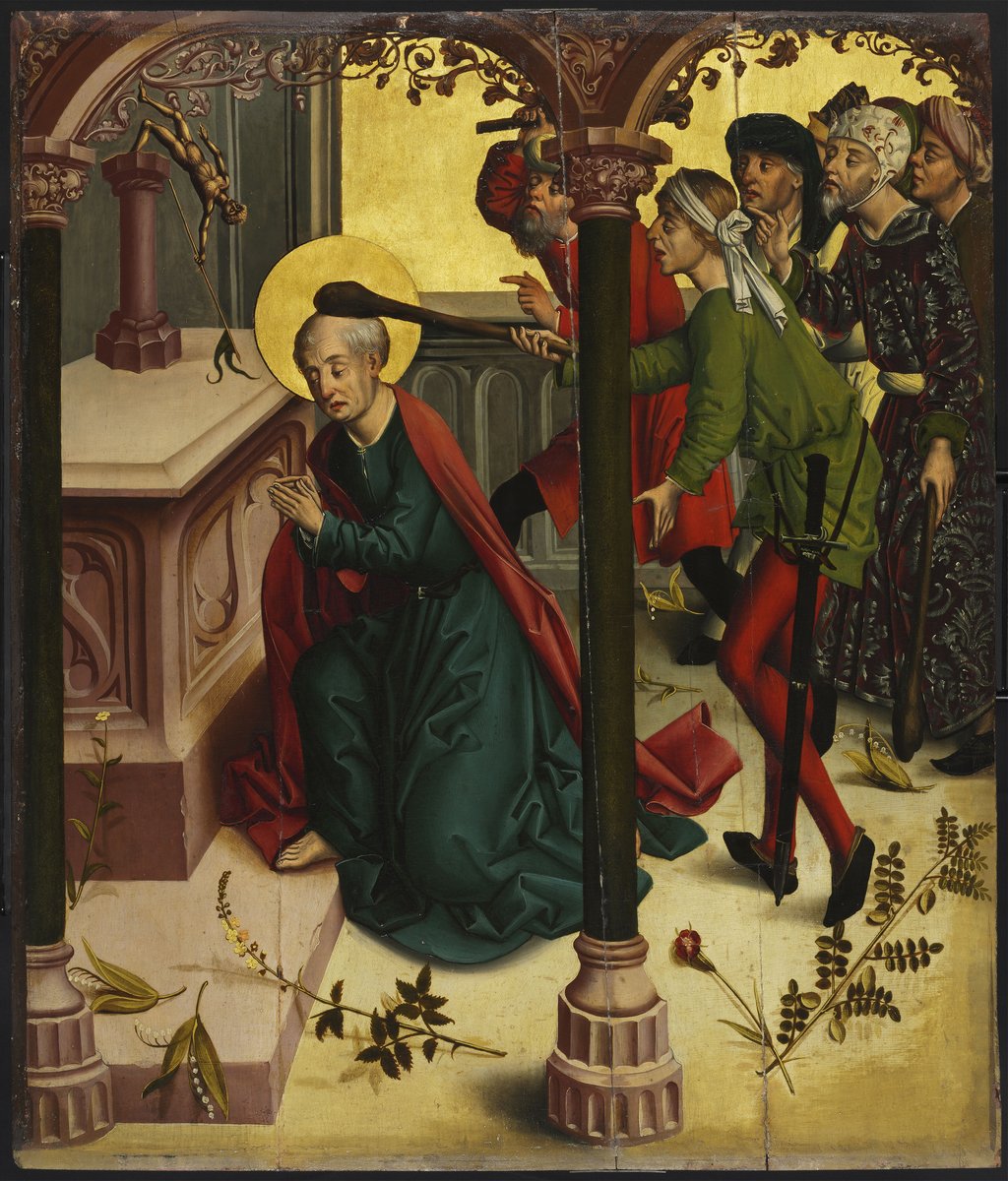
    Martyrdom of the Apostle Jude Thaddeus – painting by Master of the Winkler Epitaph

    Jude left us a strong letter in Faith, forming a book of the Bible. It is a Letter of course intended for our Salvation.

    Saint Jude also warns against those undermining God’s eternal moral Law. He warns against those undermining the Church. He warns against those exploiting the weak and the vulnerable in the Church.

    Saint Jude gives us the saving message for how to contend with these. Contend. Struggle.
    Wrestle, with all of the Word of the Lord, in all of the Sacred Scripture, with the help of the Holy Spirit, with the help of the Church.

    The very name Israel means to ‘wrestle with God.’

    Learn the True Faith.

    Help those who are struggling with faith, help them through spiritual danger. Bring them back to Communion with the Saints, the Church of the Apostles, holding Jesus Christ’s true, eternal message of Salvation.

    A last word from Saint Jude (Jude 1:24-25): ‘Now to Him who is able to keep you from stumbling, and to present you blameless before the presence of His Glory, with great joy, to the only God, our Saviour, through Jesus Christ our Lord, be glory, majesty, dominion, and authority, before all time, and now, and forevermore. Amen.’

  • World Mission Sunday 2022

    October 23rd, 2022

    The Word of the Lord speaks to our humble Christian witness on this World Mission Sunday.

    Pope Francis’ message for this World Mission Day reminds us that a missionary of Christ is not someone imposing themselves and their qualities on others, with their administrative powers.

    A missionary of Christ witnesses to Christ by their very life, doing good, forming their family in faith, keeping informed by the very Word of the Lord, living and active in their life. We do also proclaim the Word of the Lord for others to hear, for ‘Faith comes from what is heard’ (Romans 10:17).

    Pope Francis models this humble witness with his short, simple letter, which still proclaims the Word of the Lord, from Moses to the Acts of the Apostles:

    “Would that all the Lord’s people were prophets!” (Numbers 11:29)

    “You shall be my witnesses… to the ends of the earth” (Acts 1:8)

    By Baptism, we are prophets, witnesses, missionaries of the Lord, by the Power of the Holy Spirit, to the ends of the earth.

    For the Church in Canada, our particular care is for our northern missions, at the edge of the Arctic Ocean.

    A ray of sun highlighting Our Lady of Victories Church in Inuvik, NWT, Diocese of MacKenzie-Fort Smith
  • ‘Lord, have mercy on us…’ ‘Stand up and go, your faith has saved you’ (Luke 17:11-19)

    October 7th, 2022

    In a liminal place, with His face set toward Jerusalem, surrounding Samaritans would not receive Jewish pilgrims going to worship at that Temple rather than in the Samaritans’ Mount Gerizim (Luke 9:53). Meanwhile, Jewish prophets since Amos decried worship at the ‘shameful idol of Samaria, by the overconfident on the mount of Samaria’ (Amos 4:1; 6:1; 8:14; also Micah 1).
    The Samaritans did not have those writings, only their version of the Torah, not the Jewish Law and the Prophets.

    In this liminal place, ‘keeping their distance,’ ten lepers pleaded for mercy like the psalmist (123:3): ‘Have mercy upon us, O Lord, have mercy upon us.’

    The Healing of Ten Lepers – James Tissot

    “Go show yourselves to the priests.” As prescribed by the Law (Leviticus 13-14). To make sacrifices of thanksgiving and atonement, to be received back into community, back in from the liminal places.

    ‘As they were going they were cleansed.’
    And one of them, realizing he had been healed, returned, glorifying God in a loud voice; and he fell at the feet of Jesus and thanked Him.
    He was a Samaritan.’

    The Jewish lepers were likely obediently following the commandments of the Law and of the Lord, and going to the Temple. The Jerusalem Temple explicitly barred foreigners such as the Samaritan (Ezekiel 44:9). The Samaritan’s option was to go to his own priests, to worship in thanksgiving at Mount Gerizim.

    The Samaritan offered thanksgiving and worshipped God in the loud voice of the Holy Spirit at the foot of Jesus Christ, the true Temple, on His way to the Cross.
    What a truly right and just place of worship and thanksgiving, to fall down at the feet of Christ, glorifying God.
    Love the Lord our God, worship, and give thanks… and also follow the commandments in due course, but why fast in the presence of the bridegroom (Luke 5:34-35)?
    We must take time in our journey, to thank God, the source of all true authority and power and justice in mercy (Micah 6:8).

    “Stand up and go; your faith has saved you.”

    The Lord remembers his steadfast love and faithfulness to all the house of Israel,
    All the ends of the earth have seen the victory of our God,
    break forth into joyous song and sing praises to the Lord, all the earth
    (Psalm 98).

←Previous Page
1 … 9 10 11 12 13
Next Page→