In Luke’s Gospel, we are warned that temptations abound to not serve in Faith, but we are to serve in Faith, and we are unworthy servants if we only do our duty. For those who fail, if they repent, we are to forgive them as often as they turn back.
Habakkuk further questions how to endure in service when injustice is heaped upon injustice, through successively evil regimes (Habakkuk 1.2-3; 2.2-4). God is Faithful to the righteous, God’s Kingdom of peace and justice will reign.
Our wanting in faithfulness in not the answer to the problem of evil. Our fidelity is the answer. Do not harden your hearts, do not put the Lord to the proof, we have seen God’s work (Psalm 95).
‘Within your Will, O Lord, all things are established and there is none that can resist Your Will. For you have made all things, the heaven and the earth, and all that is held within the circle of heaven; You are the Lord of all’ (Esther 4:17; entrance antiphon of the 27th Sunday).
Sorely poor Lazarus in Luke’s Gospel (16:19-31) is a different man to the Lazarus that Jesus raised from the dead and restored to the family of Martha and Mary in John’s Gospel (11:1-12:17). Our Lord may be looking ahead to the sign of Life He will give with his friend Lazarus, prefiguring Jesus’ own Resurrection and ultimate triumph over death (CCC§2604).
Lazarus and the Rich Man’s Table, Gaspar van den Hoecke
Luke’s Lazarus dies hungry, in poverty, in sore discomfort, with no one even venturing close enough to bury him in a corporal work of mercy.
Angels carry this Lazarus to the side of our Father in Faith Abraham (Galatians 3:6-9)
The once-common name Lazarus is a form of the name of Abraham’s servant Eliezer, meaning meaning ‘my God is help’ (Genesis 15:2). God does help poor Lazarus.
‘Happy whose help is the Lord, his hope, maker of heaven and earth, who keeps faith forever, does justice for the oppressed, and gives bread to the hungry… The Lord gives sight to the blind.’
Psalm 146:5-7
The Lord gives sight to the unnamed rich man who dies from comfort. This rich man might resemble the one Amos prophesied against, where their daily reclining on ivory-inlaid couches, feasting on lambs, drinking wine from bowls, and anointing themselves with finest oils, sadly exiles them from God and neighbour, and blinds them to impending disaster (Amos 6:1-7).
The rich man is blinded to anyone or anything beyond the table of his sumptuous daily feasting, he cannot not see Lazarus at his gate desiring only scraps of his daily bread. Lazarus is not asking too much, only what in our Lord’s Prayer: ‘Give us each day our daily bread…’ (Luke 11:3)
We recently heard from Luke’s Gospel that our Lord asks us not to focus on only our friends and relatives for our invitations to feast, but also the poor, the crippled, the lame, those who cannot repay in this life (Luke 14:1-14).
The rich man cannot hear or see this. The rich man, in illusions of self-reliance carves out a chasm between himself and the poor, and between himself and God.
‘When you were living in your wealth, when you were free to see at your own will, you did not choose to see Lazarus at your gate. How could you avoid seeing him? When he was near you did not see him, yet now you see him from a distance, even across such a chasm? This man whom you passed by a thousand times, whom you did not want to see – now you seek to have him sent to you for your salvation? Where are are all your garments now, and all your flatterers? They were a dream, and when the day came, the dream departed.’
The rich man, in torment, seeks salvation for his kin, yet still treats saved Lazarus as a servant by going over his head to father Abraham. ‘They already have the Law and the Prophets.’ ‘No, father Abraham, but if someone goes to them from the dead, they will repent.’
Saint Gregory the Great cautions against this denied request:
‘If they do not hear the words of the Law, they will find the commands of our Redeemer who rose from the dead more sublime and so much more difficult to fulfill.’
The commands of the Law and the Prophets are summarized in our Psalm (146):
‘Do justice for the oppressed, give bread to the hungry, guard sojourners, sustain and encourage the widow and the orphan.’
Our Lord Jesus Christ summarized the commandments in the greatest double-love-commandment, ‘Love the Lord your God, and your neighbour as yourself’ (Luke 10:25-28).
Further, the Lord calls us to live life to the fullest, in the beatitudes:
‘Blessed are you who are poor, for yours is the kingdom of God. Blessed are you who are hungry now, for you shall be satisfied. Blessed are you who weep now, for you shall laugh.’
Luke 6:20-23
If the rich man and his kin could not see the poor or feed the hungry, they would not likely hear our Risen Lord asking them to take this eternal heavenly view over the passing things of this world.
Our Letter to Timothy preaches well on this Gospel, although we need to read before and after the section in our missal.
‘To fight the good fight of faith, to take hold of the eternal life to which we are called, we must keep the commandment. We must flee senseless and harmful desires to be rich, through such cravings people wander from the faith and pierce themselves with many pangs. Rather, we must do good, be rich in good works, be generous and ready to share what we have, storing up treasure as a good foundation for the future, so that we may take hold of that which is truly life.’
1 Timothy 6
We do not need to look far past our own gates to see someone possibly worse off than poor Lazarus. We see and hear all the signs and all the news of all the poverty and social ills, and we can be overwhelmed. This Gospel of our Risen Lord and Saviour is not asking us to feed the 5,000 on our own. Our Lord is asking us to see and try to save one Lazarus at a time. To help them, and us, get closer to God. To be a comfort to them in this life, and give them living hope for this life and the life to come. To be inviting in Faith and Charity. To not actively ignore any Lazarus at our gate, any sign of Jesus Christ in our midst. To not actively carve out a chasm separating us from God and neighbour.
The Lord does justice for the oppressed, gives bread to the hungry, The Lord guards sojourners, the orphan and widow He sustains and encourages…
The family is the primary cell of social life (CCC§2207). The family is the natural society.
God is first. God is all. All is from God (Romans 11:36). In Him we live and move and have our being (Acts 17:28).
The first three Commandments are the Shema, to love the Lord our God with all our heart, and with all your soul, and with all your mind. Then the love of neighbour as oneself follows (Luke 10:25-37).
If we do not first care about God, the Way in Truth to Life eternal, the Way of peace in justice and charity, how can we care for our family? If we cannot model Christ’s self-sacrificial love for our family, how can we honour or show them the Way?
We would lack the wisdom of the Word – our deliberations timid, our plans unsure (Wisdom 9:13-18). Only in wisdom counselled by the Holy Spirit may our paths on earth be made straight. Only in Christ’s Sacred Heart of Mercy and wisdom may we count our days rightly, and instruct (Psalm 90:12). Only then can we be disciples, following on the narrow way of the Cross.
Saint Paul demonstrates the Christian Way of making our paths straight, and counselling our brothers, our sisters, our families, on the true Way in Faith and Charity (Philemon).
Saint Paul shows the Christian Way to set the prisoner Onesimus free, to help him live up to the meaning of Onesimus’ name, ‘useful,’ beyond being used as a slave.
Saint Paul counsels Philemon on the true love of God and neighbour as oneself, not to lose a slave, but to gain a brother in Christ, to truly build up the Christian community and the kingdom of God.
Saint Paul does not force this on Philemon. Saint Paul relies on the counsel of the Holy Spirit. Saint Paul then advocates for his brother, his child Onesimus, to his brother Philemon, as a father, as Christ shows us our Father’s self-sacrificing love.
Saint Paul does not resort to ‘systems’ or ‘isms.’ He brings one person at a time, back to the Way of the Lord, as a child of God, winning everyone back to God who is to be loved with all our heart, soul, strength, and mind.
Onesimus may have been freed to become bishop in Ephesus through the Love of God, the counsel of the Holy Spirit, and children of God guiding each other on the narrow Way of the Cross. The systems and isms of the day made Onesimus a martyr for the Faith. Christ remains Victor over the systems and isms of that day, and of our day.
Love God, and then your family, and your neighbour, as yourself.
The self-sacrificial love and faithfulness of the Lord, and the need to humbly respond in charity, is to be learned in the family (CSDC§210). Responsibilities toward parents are also to be learned in the family, to provide for needs in infirmities, illness, loneliness, or distress, recalling Jesus’ instruction on the duty of gratitude (CCC§2218).
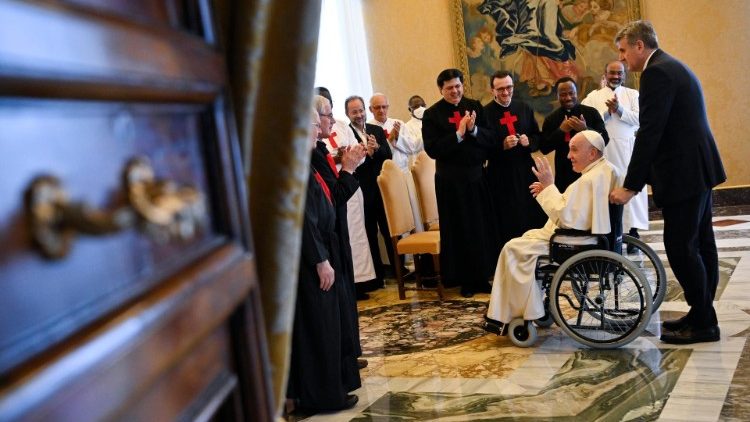
The Good Samaritan, from the Word of the Lord on the Lord\’s Day last Sunday, is incarnate in the mission and charism of Saint Camillus de Lellis whom we commemorate on this day. Earlier this month, Pope Francis greeted members of the Order that Saint Camillus founded for the care of the sick, the wounded, the elderly, the vulnerable children of God, the neighbours in our community.
This is Christ’s mission, and ours, to proclaim the Gospel, and to care for those suffering in body and spirit, in tender mercy and compassion.
Pope Francis poignantly proclaimed this from his wheelchair.
It is for all of us to be open to the Holy Spirit, to learn what the Lord is asking of us, to serve others in their need, to be like the Good Samaritan, to be like Christ.
Taking on Christ’s yoke, the burden is not all on us, Christ will bear us up and lead us into peace and rest for our weary souls (Matthew 11:28-30; Isaiah 28:12).
‘With my life-breath I desired you by night, with my spirit within me I sought You… O Lord, grant peace to us’ (Isaiah 26:9,12).
‘The Lord turns to the prayer of the desolate, and despises not our prayer’ (Psalm 102:17).
Christ speaks to the fulfillment of Isaiah’s prophecy that those who realize God’s Glory will go out to the far reaches of the earth, to bring the Word of invitation into the kingdom of God (Luke 13:22-30; Isaiah 66:19). Robert Alter’s Isaiah commentary observes that Paul and the early Apostolic missions (in Acts and the Pauline Epistles) came close to fulfilling that mission, in their times.
In the meantime, the Church has experienced the ‘discrepancy existing between the message she proclaims and the human weakness of those to whom the Gospel has been entrusted’ (CCC§853). We must find the way through penance, to renewal, to rejoin the narrow way of the Cross by which we are to fulfill Christ’s mission given us.
Christ carried out His saving work in poverty and oppression, and so we are called along this same narrow path, the Via Crucis. This is the way of Charity. The Bible would say the way of Love, but the Bible portrays Love as ‘goodwill in action… the basis of Creation as well as the basis of the divine plan of redemption’ (Hahn, Catholic Bible Dictionary, 551). God is Love (1 John 4:8). Self-sacrificial love, Charity, Agape.
We need God’s Grace to recover this understanding of Love, and this kind of Love of God and neighbour, Christ’s ultimate direction for us to guide us along the narrow way (Luke 10:25-27).
‘Without the help of grace, we would not know how to discern the often narrow path between the cowardice which gives in to evil, and the violence which under the illusion of fighting evil only makes it worse. The path is Charity, that is, the love of God and neighbour. Charity is the greatest social commandment. Charity respects others and their rights. Charity requires the practice of justice, and Charity alone makes us capable of it. Charity inspires a life of self-giving’ (CCC§1189).
Let us seek the narrow Way in Truth to Life eternal, through prayer, and through signs of the presence of the Lord (CCC§2656).
“Hear, O Lord, when I cry aloud; be gracious to me and answer me! You have said, ‘Seek My face.’ My heart says to you, ‘Your face, Lord, do I seek’” (Psalm 27).
Through prayer, through witness, through Charity – goodwill in action – let us ‘Go into all the world and proclaim the good news! Praise the Lord, all you nations! Extol Him, all you peoples!’ (Psalm 117).
Jeremiah speaks the true Word of the Lord, dividing a household under siege, a household in fear of fire and exile (Jeremiah 38). The Word of the Lord divides, piercing soul, spirit, thoughts, intentions of the heart (Hebrews 4:12).
Jeremiah testifies to the Word of the Lord, ‘that it be well with you, and you live’ (Jeremiah 38:20).
Yet the elites of the household fear this word. They are in fear for their lives, but they are in fear of the true Word of Life. They favour their own limited sense of welfare and harm reduction (Jeremiah 38:4). They seek to silence the true Word of the Lord, not killing the prophet outright, but depriving Jeremiah of the means of life, so that his testimony might not ‘harm’ the people. All are therefore cast into their respective pits of despair.
Zedekiah, put in place as ‘head of the household,’ despairs, ‘here, he is in your hand, for the king can do nothing with you’ (Jeremiah 38:5).
Ebed-Melech, a complete outsider, observes the objective truth of the situation and serves the household, pleading for mercy for Jeremiah (38:7-10). Divided against himself and the elites, Zedekiah gives Ebed-Melech the power of thirty men to raise up Jeremiah the prophet from the pit.
In fear, Zedekiah gives this outsider the power to successfully recover the voice of the Lord against the resistance of the elites. In fear, Zedekiah cannot act on the voice of the Lord against the elites. The household falls in fear and fire and exile (Jeremiah 39).
(Note that our English lectionary reads that Zedekiah gives Ebed-Melech three, not thirty men with whom to rescue Jeremiah… compare to Jeremiah 38:10)
Christ comes to baptize with the fire of the Holy Spirit, dividing to rest on all like tongues of fire (Luke 12:49-53; Luke 3:16; Acts 2:3). All are invited to be purified, sanctified, united in the one Truth of the Word of God (John 17:17-26).
Our household, we ourselves, may be divided in our response to this invitation. We may wish to hold on to values more than truth (VS§35). We know that worldly values are passing things, like worldly things and the world itself. We know that values could be otherwise. So we are divided, fighting to maintain values even through imposition and opposition to the truth, in fear, and causing fear.
Ultimately truth unites. We are united in the freeing, inseparable, greatest, eternal life-giving commandment, to love God and neighbour (Luke 10). Christ ultimately unites love of God and us on the Cross of our Redemption (John 3:14-15; VS§14).
True life eternal awaits, in the joyous splendour of Truth, in the Glory of God the Father.
‘Let us lay aside every weight…looking to Jesus the pioneer and perfecter of our faith, who for the sake of the joy that was set before Him endured the Cross, disregarding its shame, and has taken His seat at the right hand of the throne of God’ (Hebrews 12:1-4). In our struggles, we have not yet resisted to the point of shedding our blood.
The Book of Wisdom offers this answer to Ecclesiastes’ ‘Teacher’ who asked: ‘what does a person get from all their toil and strain, their toil under the sun… even at night their mind does not rest… all is vanity’ (Ecclesiastes 1:2; 2:21-23).
The Book of Wisdom (Chapter 2) summarizes the unsound reasoning, the materialism, the relativism, and the self-serving hedonism of such ‘teachers’ lacking knowledge of the Promise: all is by chance, the body is ashes, there is no remedy for life, no one returns from death, so let us oppress the righteous poor old man and the widow, let our might be our law of right, let none fail to share in our revelry in consuming the good things that exist.
We have been soundly taught to await our Passover, from slavery and darkness and death, into true life eternal. All of Salvation History offers proof of our Lord’s Faithfulness.
We are to dress for action, with our lamps lit (Luke 12:32-48). Our Lord and Saviour will return from the heavenly wedding banquet, and we will be called to share in that eternal beatitude with our Lord and Saviour. We cannot squander our responsibilities as faithful and prudent managers in the care of God’s Creation and in the care for our families and neighbours. We must act on our Faith in God’s sure promise, as our Father in Faith Abraham, journeying toward and building up God’s city from its firm foundation in sound reason (Hebrews 11:1-19).
Through Holy Communion, the faithful, though many, receive from the one bread the Lord’s Body, and from the one chalice the Lord’s Blood, in the same way that the Apostles received them from the hands of Jesus Christ Himself.
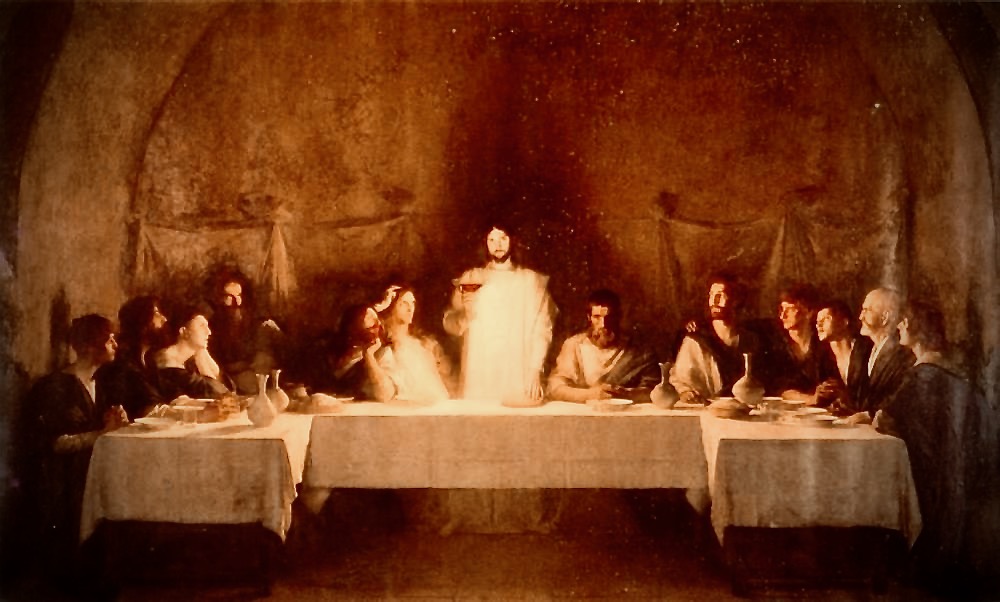
The Eucharist itself arises out of the Last Supper of Jesus Christ with His apostles. We should be conscious that it is not simply an ordinary meal, but an act of God.
Whoever eats the bread or drinks the cup of the Lord in an unworthy manner will be guilty concerning the Body and Blood of the Lord. Examine yourselves, and only then eat of the bread and drink of the cup. For anyone who eats and drinks without discerning the Lord’s Body eats and drinks judgment against themselves.
Receiving the Body and Blood of Christ in Holy Communion begins with the elevation and adoration of the consecrated Host over the precious chalice.
We hear:
‘Behold the Lamb of God. Behold Him who takes away the sins of the world’ (John 1:29).
‘Blessed are those called to the supper of the Lamb’ (Revelation 19:9).
Christ is the Paschal Lamb who offers His Life in sacrifice for sin (see Isaiah 53).
We reply:
‘Lord, I am not worthy that you should enter under my roof, but only say the word and my soul shall be healed’ (Matthew 8:5-13).
This is an act of humility. We are recognizing our unworthiness to have our Lord and Saviour come into our souls in Holy Communion and dwell with us. (Sri, A Biblical Walk Through the Mass, p. 173). It is also an act of trust that our Lord can heal us, as He becomes the most intimate Guest of our soul in the Eucharist.
When the priest himself receives Holy Communion, the communion chant is started by the cantor and choir. This provides for a spiritual union through a unity of voices, prayerfully repeating the communion antiphon in gladness of heart (GIRM #86). The chant continues for as long as the Sacrament is being administered to the faithful.
After the priest receives Holy Communion, other ministers in the sanctuary receive Holy Communion from the priest. Ministers distributing Holy Communion receive from the hands of the priest the vessel containing the Holy Eucharist. It is not permitted for any of the faithful to take the consecrated Bread or the Sacred Chalice by themselves or hand them on from one to another among themselves (GIRM #160, see also pastoral notes 250 and 267). Holy Communion is to be received, not taken.
Then the Priest and ministers go to the Communion stations. The faithful who wish to receive Holy Communion approach in procession. Those who do not wish to receive Holy Communion may remain at their place in prayer, or join in singing the communion antiphon.
Standing before the minister to receive Holy Communion, the faithful should bow their head in reverence before our Lord in the Blessed Sacrament (GIRM #160, pastoral note 271).
Then the faithful reach out their hands to embody their desire to receive God’s gracious gift of salvation (Pastoral note 249). They place their dominant hand underneath the other, to steady their flattened, upward facing palm. As Saint Cyril of Jerusalem advised in 348, ‘when you approach Holy Communion, make your hand into a throne, which will receive the King… Hallow your hand to receive the Body of Christ.’
The priest or minister waits until the faithful is in place and composed (Pastoral note 271). The minister raises the Host to the eye level of the minister and says clearly: ‘The Body of Christ.’ No other words or personal names are to be added to the ritual words (Diocese of Saint John guidelines on Holy Communion).
Our Amen acknowledges that this IS the Lord Jesus Christ Himself, Body, Blood, Soul, and Divinity, sacramentally present under the appearances of Bread and Wine (Cardinal Collins, #4). Our Amen means that we commit ourselves to be disciples of Jesus Christ in the community that celebrates this Eucharist. Our Amen also tells the minister that we are a Christian in Communion with the Catholic Church, prepared to faithfully receive Holy Communion.
Allow the minister to place the host securely in the palm and then to withdraw their hand. Do not close your hand or grasp their hand, which risks contamination or dropping a consecrated Host. If a Host is dropped, if the faithful does not reverently retrieve and consume the Host, then the minister must do so or return it to the corporal on the altar for reverent disposition (Diocese of Saint John guidelines on Holy Communion).
The faithful, with their dominant hand, carefully places the Host in their mouth to consume the whole of it, in reverence (GIRM #160). The faithful does this in front of the minister from whom they received it, mutually assuring reception of Holy Communion (Diocese of Saint John guidelines on Holy Communion).
It should always be evident that we are handling not bread and wine, but the Real Presence, the Body and Blood of Jesus Christ, our Lord and Saviour (Cardinal Collins, #4).
After receiving Holy Communion, the faithful process back to their place. They may silently praise God in their hearts and pray to Him whom they have just received (GIRM #45).
When the distribution of Holy Communion is complete, the ministers return to the altar to place their vessels on the corporal, to be gathered by the priest (GIRM #163). Remaining Hosts may then be carried to the tabernacle for the reservation of the Eucharist. The priest himself consumes any remaining consecrated wine. Servers assist the priest in clearing the altar and purifying the vessels.
Concluding the Communion Rite, the Priest pronounces the Prayer after Communion, in which he prays for the fruits of the Mystery just celebrated (GIRM #89).
When the Sacred Scriptures are read in the Church, God himself speaks to his people, and Christ, present in His Word, proclaims the Gospel. Therefore, the readings from the Word of God are to be listened to reverently by everyone, for they are an element of the greatest importance in the Liturgy (GIRM §29). Let us all be attentive to the Word of the Lord, as the Lord’s people were in Nehemiah 8.
The Lector proceeds to the ambo for their proclamation of the Word. The ambo is a dignified place suitable for the proclamation of the Word of God. The ambo is dedicated for the reading of Scripture, the Psalms, and the Easter proclamation of the Exsultet. Likewise it may be used for the Homily and for announcing the Prayers of the Faithful (GIRM §309).
If a Lector approaches the altar (from the nave of the church) or crosses the altar (from across the sanctuary), they make a profound bow to reverence the altar. If they leave or cross the sanctuary after their proclamation, they again reverence the altar with a profound bow.
Proclamation is to be in a loud and clear voice, in a tone corresponding to the solemnity of the gathering and the genre of the Scripture itself (a reading, a prayer, an explanatory comment, an acclamation, or a sung text) (GIRM §38).
At the end of the First Reading, after a brief pause to indicate its separation from the Scripture proclaimed, the lector pronounces the acclamation: ‘The Word of the Lord.’ All reply, ‘Thanks be to God.’ A further moment of silence may be observed, so that all may meditate on the Word (GIRM §128).
‘The Psalm is more than a response to the first reading: it is a sung proclamation of God’s Word and fosters meditation on what the assembly has heard. It is a carefully selected, prayerful response to the Word of the Lord just proclaimed. The psalm is a song; every effort should be made to ensure that it is sung. The psalm is sung in responsorial style: the cantor sings the verses of the psalm and the assembly repeats the refrain. The psalm is never introduced with the phrase “The response to the psalm is…” or any other introductory words’ (CCCB Pastoral Notes for the Missal, # 167-168).
In the absence of a psalmist or cantor, a lector proclaims the verses of the Psalm and the people make the response (GIRM §129).
If there is to be a Second Reading before the Gospel, the lector proclaims it from the ambo. All listen and at the end reply to the acclamation, as above (GIRM §130).
‘If there are several readings, it is well to distribute them among a number of lectors. However, it is not appropriate that several persons divide a single element of the celebration among themselves, e.g., that the same reading be proclaimed by two lectors, one after the other, with the exception of the Passion of the Lord’ (GIRM §109).
Especially in the proclamation of the Gospel, the Risen Christ speaks to His disciples in every time and place (see Evangelii Gaudium §19).
Before the Gospel, all rise, with the chant of the Alleluia, ‘Praise the Lord’ (Revelation 19).
If a deacon is present to proclaim the Gospel, he bows before the celebrant, hands joined, and asks, ‘Your blessing, Father‘ (GIRM §175). The Priest blesses him, saying, ‘May the Lord be in your heart.’ Signing with the Cross, the deacon responds with his Amen. If there is no procession with the Book of Gospels, the deacon proceeds to the ambo, reverencing the altar whenever passing in front of the altar.
At the ambo, the deacon or priest greets the people, hands joined, saying, ‘The Lord be with you.’ The people reply, ‘And with your spirit.’ Then he says, ‘A reading from the Holy Gospel (GIRM 134). The Sign of the Cross is made on the book with the thumb. Then the Sign of the Cross is made with the thumb on the forehead, mouth, and heart, which the people do as well. The people acclaim ‘Glory to You, O Lord.’ After proclaiming the Gospel with joined hands, he acclaims, ‘The Gospel of the Lord.’ All reply, ‘Praise to You, Lord Jesus Christ.’ He venerates the book with a kiss, praying the Per evangelica dicta, deleantur nostra delicta, ‘Through the words of the Gospel may our sins be wiped away.’ If the bishop is presiding, he may kiss the book and, if appropriate, impart a blessing to the people with the Book of Gospels (GIRM §175). The book is not to be raised high; only the Pope may bless the assembly with the book after the Gospel has been read (Elliott, Ceremonies of the Modern Rite, p.97). The people then sit to attend to the homily.
The homily follows, as an integral, liturgical act of living commentary on the proclaimed Word of God (GIRM §§ 65, 213; SC § 52). As a liturgical act, the homily should be offered by the celebrant himself, or by a concelebrating priest, or, if appropriate, a deacon (GIRM §66). A moment of meditative silence is observed after hearing the Word of God and the homily.
A Homily is prayer of worship over the Word of God, offered with and for the gathered faithful, to admonish and challenge them to imitate the Lord’s beautiful teachings (CCC §1345). With a compelling desire to present Christ who stands at the centre of each homily, the prayer of the homily might realize Pope Francis’ exhortation of the homily as an intensely happy or consoling encounter with God’s Word for our revitalization in Christ’s mission (EG§135).
The celebrant rises to lead the assembly in a public profession of faith, in the Creed. The Altar is the focus of attention during the recitation of the Creed. All bow their heads at the Name of Jesus, and all bow at the conception by the Holy Spirit and incarnation of Jesus Christ, up to and including the name of Mary.
The celebrant, still standing, faces the people and introduces the Prayer of the Faithful using one of the Missal formulas or simply ‘Let us pray.’ The celebrant faces the altar with hands joined in prayer, while the deacon, lector, or cantor read the prayer intentions at the ambo. The minister is in place to pray the intentions immediately following the celebrant’s introduction, and remains there in a prayerful posture until the concluding prayer and the assembly responds with their Amen (CCCB Pastoral Notes for the Missal, # 197).






.png)
