• Bible Study Resources
    • Census
    • Links
      • The Word and Liturgy Links
      • Art Links
      • Sacred Music
      • Poetry Links
      • Sacrament of Matrimony Links
      • Catholic Education
      • Christian Legal Issues
      • Sacrament of Reconciliation Links
    • Prayer Cards
    • Starting a Schola
    • The Sacrament of Baptism
    • Funeral

Father David Rioux's Website

  • ‘Whoever believes in Me, even if he dies, will live, and everyone who lives and believes in Me will never die’ (John 11:1-45).

    March 26th, 2023

    Did Lazarus expect to return to this life, rather than into eternal life, in the Resurrection, on the last day?

    This is a family of Faith, of belief ‘in the resurrection on the last day.’
    They believe that Jesus Christ is the Son of God, our Saviour, our Hope of eternal Life, through whom we will see the glory of God.
    We will ultimately be united with God who is Love, with all those we love, who love God (1 John 4:16).
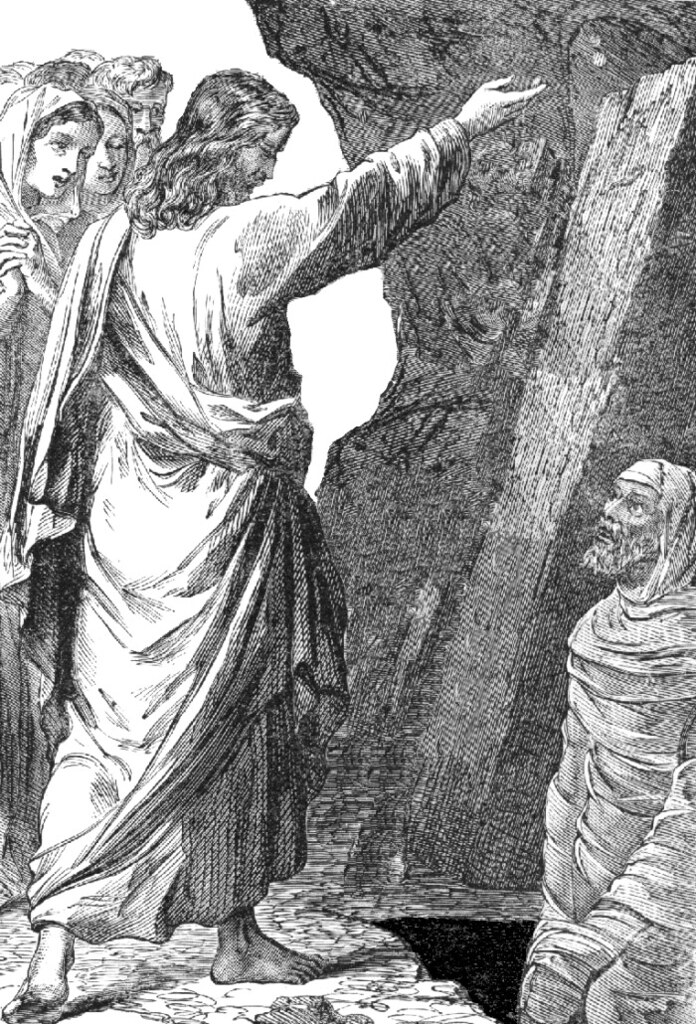
    Lazarus raised from the tomb by Jesus.

    Yet Christ’s trumpet call, with Divine authority, cries out, ‘Lazarus, come out.’ Christ calls Lazarus’ soul back to his body, ‘sleeper, awake, and arise from the dead’ (Ephesians 5:14). God gives life to our mortal bodies, through His Spirit dwelling in us (Romans 8:8-11).

    Christ calls Lazarus back to this life, to the glory of God, so that many more would come to believe in the Truth of eternal Life.
    Back to God’s saving work, in this life. Yet yearning for eternal life: ‘I hope for the Lord, my being hopes, more than the dawn-watchers for daybreak’ (Psalm 130).
    But Martha is actively sorrowing and seeking the ‘teacher,’ and Mary is suffering in silence.
    They may have confidence in an idea of the resurrection on the last day, but in their human weakness, they have needs in the here and now, to overcome breaks in relationships in this life.
    So Lazarus is brought back to this life, he has been given this purpose, to show that suffering with Christ is not meaningless.

    Lazarus is a great sign for us, even if he is but one creature raised, out of all of God’s universal Creation.
    It is less than the promise in Ezekiel (37:1-14) that the Lord can put His Spirit in us, that we may live.
    In that promise, we have that amazing image made into the song, ‘Ezekiel connected those dry bones, in the valley of the dry bones, those bones will walk, when they hear the Word of the Lord.’
    Those bones were dry, past mourning. Those bones were slain, scattered. ‘Man, can these bones live?’
    The Lord breathes His Spirit in them, restoring them to life.
    And that is still less of a miracle than our being raised to eternal Life in Christ. The Resurrection and the life, eternal life, is embodied, perfected, glorified, never to die again.

    ‘If you had been here, he would not have died.’

    Even as faithful disciples of Christ, we can say with Martha and Mary, Lord, where were you? Where are you?
    We can profess in our Creed, ‘I believe in the resurrection of the body, and life everlasting.’
    We can take it as a simple teaching, from ‘the Teacher.’
    Worse than that, we can take it as a condemnation of Christ, like the weeping witnesses in this Gospel who actively disbelieve in God because they perceive needless suffering and death in their world.
    They do not want the true miracle of Creation in God’s Saving Plan, they want magical solutions, now, on their terms.

    God needs no magic, no sleight of hand, nothing hidden, nothing done in darkness.
    Our Lord simply invites faith, true belief in Him, personally, to call on Him, not an abstract idea of him.
    Our Lord knows all, He knows our sufferings, He knows our needs, He weeps with us, in His true compassion for us. He has suffered everything with us, and for us.

    But he wants us to pray with Him.
    ‘Where have you laid him? Come, and see.’
    That all may be in the light, nothing hidden, no magic, no deception –
    ‘Take away the stone.’
    But then we object.
    We need things contained, closed up, hidden. ‘There will be a stench.’
    We hold back. We hold Christ back.
    He waits for us… remaining two days, or more, He waits for us.

    ‘If you had been here…’

    This is why we come here, to the Mass, on this Lord’s Day.
    It is why we call on the Lord, whenever we have need, whenever we are suffering.
    In this Mass, we pray: ‘As true man, Jesus weeps for Lazarus his friend. As eternal God, Jesus raises Lazarus from the tomb, just as, taking pity on us, He leads us by Sacred Mysteries to new Life’ (Preface).

    We are offered these Sacred Mysteries in our Sacraments.
    Our Lord and Saviour is always and everywhere Living to intercede for us.
    We need signs to bring us to the fullness of true Faith, as Lazarus was called to be a great sign for Faith for his family.
    We have the great sign in the cleansing waters of Baptism, into new Life and Resurrection in Christ.
    We are given Christ’s very Life, in His very Body and Blood, in reverently receiving Holy Communion, through which our Lord heals us and brings us strength.
    We have the powerful anointing of the sick, through which we pray with the Lord to save us, and raise us up.
    In this Lenten Season, we have the Sacrament of Reconciliation.

    ‘If you had been here…’
    The Lord is here, waiting, inviting us to the Confessional, a place of victory over the the many sufferings and deaths that afflict us – broken relationships, hurts, misfortunes… restoring us to that new Baptismal Life and Resurrection in Christ.
    The Lord waits in the Confessional, asking us to remove the stone we put in front of our tomb.
    ‘There will be a stench…’
    No, no more.
    You will be unbound, free to go, free to truly believe in Jesus Christ, our Lord and Saviour.

    ‘Whoever believes in Me, even if he dies, will live, and everyone who lives and believes in Me will never die.’

  • Fashioning idols out of letters of the Law, against the Word, the Charity of the Holy Spirit, the Divine Lawgiver, and the Author of Life (John 5:31-47)

    March 23rd, 2023

    Our Gospel presents charges against Jesus Christ, apparently based on law. What law? Is this a fair trial?

    The charge starts with a select citation of Scripture. To the authorities, the letter of the Law states: ‘observe the Sabbath day, to keep it Holy, as the Lord your God commanded you’ (Deuteronomy 5:12).

    Moses with the Ten Commandments, Rembrandt

    If Jesus is continuing His Father’s life-giving work in Creation, the authorities see Him contradicting His Word.
    Yet the rest of that Word, in the Law, answers, ‘if on the Sabbath you see the life or livelihood of your neighbour or even your enemy in need of rescue, you shall help them, you shall lift them up’ (Deuteronomy 22:4).
    Jesus asks ’is it lawful on the Sabbath to do good or to do harm, to save life or to kill?’ (See Mark 3:4, and Luke 13:15).
    The Sabbath was made for us, to be a blessing (Mark 2:27). Our Lord offers us a common day of rest, to help us gather and restore right relationship with God, family, neighbour, and community, in thanksgiving for life.

    The Law of the Lord is all about Life. Life in generous care and concern for others, giving others their due. The Greatest Commandment is to Love God, and neighbour as oneself (Matthew 22:34-40).

    These authorities cannot admit the Holy Spirit of the Divine Law of Life in their court.
    They cannot admit of the possibility that Jesus Christ is the Lord of Life, even if all of His healing works in restoring and saving Creation testify to highest heaven, to the Glory of God the Father.
    The idol they have made of their god is not allowed to work on their sabbath; their god and their law must work only on their terms. Anything else must be cancelled, killed.
    They do not want the Lord giving His Life for us, they are intent on taking his life away, to keep praise for themselves and their idols.
    They are their own judge of the law, they decide what is good and what is evil (see James 4:11-12; Isaiah 5:20).
    They rule that they and their idols are good, but our Lord and Saviour evil.

    This is not a fair trial.

    The authorities skip ahead to sentencing, selecting another line for their law – ‘whoever blasphemes the name of the lord shall surely be put to death’ (from Leviticus 24:16).
    The authorities say they cite Moses here, yet what does Moses do?
    We hear Moses interceding with pleas of mercy and repentance for even the most brazen of idolizers, saving his people.
    Jesus reminds that the Scriptures of Moses provide an entire Salvation History showing the Way of the Lord fulfilled in Jesus Christ in their very midst.
    Jesus testifies for us, ‘so that you may be saved.’

    In this season of prayer, almsgiving, and fasting, let us pray over which law, which Way to follow for Life.
    Selected, shifting laws serving idols and sentencing to death? Or,
    the eternal, Divine Law, serving God and neighbour in Truth, offering Life, in abundance (John 10:10).

  • The finger of God, against stiff necks and hardened hearts (Luke 11:14-23; Jeremiah 7:23-28)

    March 16th, 2023

    The ‘finger of God’ was recognized in the signs and wonders leading up to God’s saving His people from slavery in Egypt, while hardness of hearts prolonged everyone’s suffering (Exodus 8:19).

    Jesus Christ heals, bringing about the Kingdom of God, by the ‘finger of God.’

    In that hour, he healed many people of diseases and plagues and evil spirits, and on many who were blind He bestowed sight…the blind receive their sight, the lame walk, lepers are cleansed, and the deaf hear, the dead are raised up, the poor have good news preached to them…”

    Luke 7:18-23

    Yet, with stiff necks and hardened hearts, to test Him, they ask for a sign from heaven. They are not with the Lord, they are against Him. They will not follow the Way in Truth to eternal Life, to bring about the Kingdom of God. They will only be scattered.

    Jeremiah recalls that from the very day God saved His people from slavery in Egypt, God ‘untiringly sent all His servants the prophets.’ God sends Jeremiah with the warning ‘they will not listen to you either.’ Hearts heardened, stiff-necked, backs on God, they cannot hear the Word of the Lord. ‘Faithfulness has disappeared, the Word itself is banished from their speech.’

    We see this now. How do we listen to the Word of the Lord, so that He will be our God, and we will be His people? What does this chapter of Luke’s Gospel begin with? Prayer.

    In this Lenten Season of prayer, almsgiving, and fasting, we pray.

    We meditate upon the Word of the Lord in the Bible. What is the Word saying to us, personally? What is it calling us to, personally? How does the Word call us to return to the Way of the Lord, to face the Lord, to bow our necks and knees, to receive back from the Lord natural hearts in place of our hardened hearts?

    To encourage our prayer, let us hear from Tertullian’s treatise on prayer, from today’s Office of Readings:

    Since God asks for prayer offered in spirit and in truth, how can he deny anything to this kind of prayer? How great is the evidence of its power, as we read and hear and believe.

    Of old, prayer was able to rescue from fire and beasts and hunger, even before it received its perfection from Christ. How much greater then is the power of Christian prayer. No longer does prayer bring an angel of comfort to the heart of a fiery furnace, or close up the mouths of lions, or transport to the hungry food from the fields. No longer does it remove all sense of pain by the grace it wins for others. But it gives the armor of patience to those who suffer, who feel pain, who are distressed. It strengthens the power of grace, so that faith may know what it is gaining from the Lord, and understand what it is suffering for the name of God.

    In the past prayer was able to bring down punishment, rout armies, withhold the blessing of rain. Now, however, the prayer of the just turns aside the whole anger of God, keeps vigil for its enemies, pleads for persecutors. Is it any wonder that it can call down water from heaven when it could obtain fire from heaven as well? Prayer is the one thing that can conquer God. But Christ has willed that it should work no evil, and has given it all power over good.

    Its only art is to call back the souls of the dead from the very journey into death, to give strength to the weak, to heal the sick, to exorcise the possessed, to open prison cells, to free the innocent from their chains. Prayer cleanses from sin, drives away temptations, stamps out persecutions, comforts the fainthearted, gives new strength to the courageous, brings travelers safely home, calms the waves, confounds robbers, feeds the poor, overrules the rich, lifts up the fallen, supports those who are falling, sustains those who stand firm.

    All the angels pray. Every creature prays. Cattle and wild beasts pray and bend the knee. As they come from their barns and caves they look out to heaven and call out, lifting up their spirit in their own fashion. The birds too rise and lift themselves up to heaven: they open out their wings, instead of hands, in the form of a cross, and give voice to what seems to be a prayer.

    What more need be said on the duty of prayer? Even the Lord himself prayed. To him be honor and power for ever and ever. Amen.

    From the treatise On Prayer by Tertullian, priest
    (Cap. 28-29: CCL 1, 273-274)
  • Memorial of Saint Frances of Rome

    March 9th, 2023

    In our Lenten Season, our daily Word is helpfully direct and focused for our work in returning to the Way of the Lord.

    Jeremiah (17:5-10) recalls our Psalm (1):
    If we follow the Way of the Lord, we are blessed, and happy. We are like trees planted by streams of water, our leaves do not wither, we are generous, and we truly prosper.
    If we rely on mortal flesh as our strength… these dry up, like chaff, and are lost.

    Our Gospel is from Luke (16:19-31), of the rich man and Lazarus, recalled in later musical works as Dives Malus, the wicked rich man.

    Every day, the rich man trusted in himself, in his resources, sumptuously feasting, ignorant of the needs of Lazarus at his gate.
    Does this make him wicked, Dives Malus?

    In our youth, in our health, in our power, we might easily rely on our own resources. Often, it is only when our mortal strength fails us that we realize our dependency on natural order, and on the providence of God.

    Jeremiah warns that the Lord probes the heart. James (5:5) warns that living in self-indulgence fattens the heart, rendering us blind, ignorant, indifferent to others in their need.

    Is this wicked, or simply omission?

    It is certainly not following the Way of the Lord, in the Great Commission, to follow and teach all of the Law and the Prophets, to love God and neighbour as oneself (Matthew 22:38-40; 28:16-20).

    And so, in this Lenten Season, we follow the call to pray, that we may act in the Way of the Lord, in Charity, with almsgiving.

    In this Lenten Season, our memorials of the lives of the Saints are muted, that we may remain focused on our Lenten task of returning to the Way of the Lord. Yet today’s Saint Frances of Rome helps us with her example in these tasks.

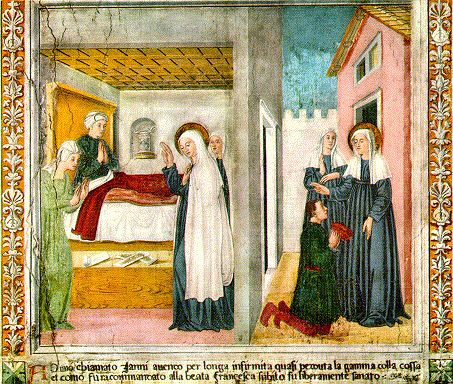
    Saint Frances of Rome, Antoniazzo Romano
    Serving the household in Faith, and serving the poor at the gate

    Frances was of nobility yet she heard our Lord’s call to service, she saw Lazarus at the gate. She cared for the poor, more than her house might have wished, yet with her prayer, her house resources were not depleted.

    As in our Psalm (1), she and those she served prospered, like trees planted by streams of water.

    She obeyed her family’s insistence for her to marry rather than enter religious life, and she devoted herself to the care of her husband and her household in faith. She became patron saint of homemakers. She also organized a group of women to continue her outreach to the poor.

    When plague came, her resources were depleted. She sold possessions, she begged alms for the poor left in misery in the wake of the plague.

    She remained constant in the Way of the Lord, caring for her husband, her children, her household, and the poor in her care. With her prayer, all were constantly nourished with the careful Love of God, not herself alone.

    She continues even now. We can still see her, lying in state in her reliquary, still with her prayer book in hand, still praying for us with our Communion of Saints.

    May we we follow this Way of the Lord, to be blessed, and happy. To be like trees planted by streams of water, never withering, but being generous and truly prosperous.

    Let us pray again with our Collect: O God, who delight in innocence and restore it, direct the hearts of your servants to yourself, that, caught up in the fire of Your Spirit, we may be found steadfast in faith and effective in works.

  • ‘Now help me, who am alone and have no one but you, O LORD, my God’ (Esther 4).

    March 2nd, 2023

    In this Lenten season of prayer, fasting, and almsgiving, today’s Word speaks to the power of prayer, and intercessory prayer.

    We hear in our Gospel Word and in the Mass prayers: ‘Everyone who asks, receives; and the one who seeks, finds; and to the one who knocks, the door will be opened‘(Communion Antiphon; Matthew 7:8).

    Will everyone get whatever they desire by prayer?

    We hear in our Lord’s Prayer, to Our Father in heaven, ‘Your kingdom come, Your Will be done…’ (Matthew 6:9-13).

    Further we hear from our Lord that what we truly seek is the kingdom of God and His righteousness. That is the door which we are meant to open, for truly good things to be given (Matthew 6:33).

    Our heavenly Father gives only truly good things.

    This Lenten Season of repentance and conversion is for us to seek humility and forgiveness, as we serve and forgive others, to have clean hearts, open to our heavenly Father’s divine Will for our good.

    The prayers at the beginning and the end of this Mass ask for and seek for our Lord’s help for us, to open the door to God’s Will, for our good.
    Our final blessing asks for heavenly aid that we may know what is right to ask, so that we may receive what we truly need (from the Prayer over the People).
    Our opening collect prayer asks for the Holy Spirit to help us ponder on what is right, and to make haste in carrying it out, for the glory of God (Collect).

    We have the Word of the Lord to help us know the Will of the Lord, and what is right.

    Today’s Word summarizes all of the Law and the prophets in ‘do unto others as you would have them do to you‘ (Matthew 7:12).

    When we pray, asking, seeking, open to good things, nothing is too small or too great for our Lord to bring about His good Will.

    ‘Nothing is impossible with God. God is the Lord of all the universe, God established all its order, all of history is subject to God’ (Catechism of the Catholic Church § 269).

    Our reading from the Book of Esther illustrates this point (Esther 4).

    Esther, meaning ‘star,’ is an orphaned Jewish girl living among the Jewish exiles left in Persia.

    She is neice of Mordecai, a faithful Jew working there and looking after her.

    Living there is precarious. The local king’s queen disobeys an order. She is deposed, and punished as a warning to others.

    The king seeks a new queen and finds Esther pleasing, although she is warned by Mordecai not to reveal her Jewish heritage.

    Esther Denouncing Haman, Ernest Normand

    Mordecai, and all faithful Jews in Persia, incur the wrath of a government official for not worshipping his government’s false idols.
    False accusations lead to a decree of the extermination of faithful Jews from Persia.

    Mordecai turns to prayer and fasting, in sackcloth and ashes.

    He sends warning to Esther, and she faithfully does the same.

    Esther prays: ‘As a child I used to hear from the books of my forefathers that you, O LORD, always free those who are pleasing to you. Now help me, who am alone and have no one but you, O LORD, my God‘ (Esther 4).

    By prayer, for God’s Will, for God’s Saving Plan, Esther is given opportunity to reveal to the king the falsity of the accusations against her people.

    Esther’s faithful intercession is commemorated in the Jewish Purim feast.

    Esther’s faithful prayer intercedes with a king to save the people of God.

    This reminds of the intercession of Our Lady, Mother of God, Mother of the Church, who can intercede for us with the King of Kings.

    Let us commit ourselves to our conversion, to learn to pray in faith for that which is truly for our good. Our Lord Jesus Christ intercedes for us in this, our asking, seeking, and knocking.

    After all, He Himself is the door and the Way (CCC §2609).

  • ‘Whoever wishes to come after Me must deny himself, take up his cross, and follow Me’ (Mark 8:34—9:1)

    February 17th, 2023

    To truly follow Christ, is to follow the Way of the Cross, sacrificing in this life, to attain true Life eternal (Gospel of Saint Mark 8:34-9:1).

    When we sacrifice, we build up our family in Faith and virtue. We witness to Hope, in Charity, in building up our community.

    The (Little) Tower of Babel, Pieter Brueghel the Elder

    The alternative is shown in Babel (Genesis 11:1-9).
    A construct in pride, with technology, overreaches against God, for fear of being toppled.
    Any solely human construct in imposing pride will be toppled, by mortality, or by the next solely human construct.

    God, Creator of all, sees all of this, and surveys the deeds of men and women throughout the world (Psalm 33). The Lord oversees all the nations, their devising, their rising, and their toppling. The Lord does not impose through limited human power and force. The Lord creates, in Charity, in Justice, and in Mercy, all carefully measured, through His Word. The Lord who creates us knows us and knows our hearts. The Lord counsels us through His Word, for all generations, unto true Life eternal. If only we follow Christ, on the Way of the Cross.

    May Your kindness, O Lord, be upon us, as we have yearned for You
    (Psalm 33:22).

  • Faith of mothers and fathers, for their children

    February 8th, 2023

    Today’s readings remind that when a man leaves his father and mother
    and clings to his wife, and the two of them become one flesh (Genesis 2:18-25), when they become parents themselves, they care for their sons and daughters in faith.

    The natural right and duty of parents to raise and educate their children, especially in the Faith, is primordial and inalienable. Parents respect their children as children of God. They provide a home for their children that is well suited for education in the virtues. This requires self-mastery, for self-sacrifice, for solidarity, for building up a family, the primary cell of society (see the Catechism of the Catholic Church §§ 2221-2231).

    Our Psalm (128) speaks to the blessings that can be in Christian family life. ‘You shall eat the fruit of the labour of your hands; you shall be happy, and it shall go well with you.
    Your wife shall be like a fruitful vine within your house; your children will be like olive shoots around your table.
    Thus shall the man be blessed who fears the Lord.’

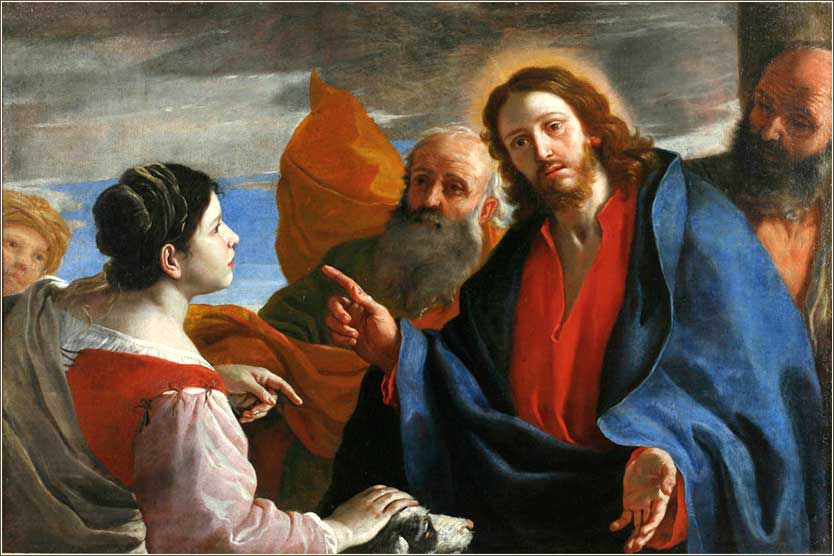
    So of course when all is not well in the family, indeed, when a child is possessed by the unclean spirits that prowl for souls in this world, the woman seeks healing in Faith for her daughter. She travels. She perseveres in faith, advocating for healing for her daughter, even when she is told, in Saint Augustine’s translation, let the children of Israel be fed first (Mark 7:24-30). On account of her humble faith, her daughter is cleansed, healed, saved, restored in her home. To be raised in the Faith in Christ, which saves.

    Jesus and the Canaanite Woman, Mattia Preti
  • Corban

    February 7th, 2023

    Today’s readings include the only Gospel reference to a corban, an offering consecrated to God (Mark 7:1-13).

    It sounds honourable, in keeping with the accumulated human traditions of the Pharisees, to set apart for God. The name Pharisee itself means to be separated, divided, set apart from all that is not holy, to live all of life in respect for God. It sounds in keeping with God’s work in Creation, which we begin reading anew this week.

    God divides day from night, land and sea from the vaults of heaven, so that earth could be filled with all sorts of life in our beautiful temple garden, to be tended by humans, made in God’s image and likeness, to continue co-creating with God, to be ‘very good’ within the goodness of Creation (Genesis 1).

    Our Psalm (8) expresses our gratitude. ‘What is man that You should note him, and the human creature, that You pay him heed, and You make him little less than the gods, with glory and grandeur You crown him, You make him rule over the work of Your hands… Lord, our Master, how majestic Your Name in all the earth!’

    Yet a true sacrifice to God must be in gratitude to God, seeking the true love of God and neighbour as oneself, as we hear in the greatest Commandment (Mark 12). The Lord desires ‘steadfast love and not sacrifice, the knowledge of God rather than burnt offerings’ (Hosea 6:6).

    Setting oneself apart from one’s own parents, from one’s own co-creators in life, is not a true or good offering to God. How could we ever say ‘any support you might have had from me is qorban, dedicated to God’ (Mark 7:11)?

    Our Lord cites the Fourth Commandment, honor your father and your mother. Even if nothing else, they give you life, to live, ‘that it may go well with you in the land the Lord your God is giving you’ (Deuteronomy 5:16).

    As much as we can, we give moral and material support to our parents, our co-creators in life with God, especially in times of illness, loneliness, or distress (CCC§2218).

    ‘Whoever honours his father atones for sins, and whoever glorifies his mother is like one who lays up treasure.
    Whoever honours his father will be gladdened by his own children, and when he prays he will be heard.
    Whoever glorifies his father will have long life, and whoever obeys the Lord will refresh his mother’ (Sirach 3:2-6).

    Let us make our offerings to God good and true, in gratitude, and in the knowledge of God’s Love and His Commandments.

    Let us be wary of making pious sounding excuses to set rightful sacrifices apart. After all, the only other place in the Gospels where a form of korban is mentioned is in Matthew (27:6), where Judas throws the 30 pieces of silver he was given to betray our Lord onto the ground, and that blood money was not suitable for the treasury…

    Judas returning the thirty pieces of silver, Rembrandt
  • I AM the Light of the world, says the Lord; whoever follows me will have the Light of eternal Life

    February 4th, 2023

    From the Gospel acclamation, and John 8:12

    The Light of the World, William Holman Hunt
  • How abundant is your goodness that you have laid up for those who fear you, and accomplished for those who take refuge in you, in the sight of everyone! (Psalm 31:19)

    January 30th, 2023

    Our Letter to the Hebrews (11:32-40) paraphrases the tremendous Salvation History of the saints who persevere, who heal, who restore to life, not through worldly power and force, but through prayer and trust in God.

    These saints are famous, infamous, unlikely.

    Their testimony is all amazing.

    As Saint Paul writes, in the midst of their lost generations, they shine like lights in the world (Philippians 2:15).

    We continue to have great young saints, lights shining in the world, enduring hardships, like Chiara Badano and Carlo Acutis.

    We have the witness of Pope Francis, journeying to the Congo and South Sudan, supporting Christians in their Faith, where they are being martyred.

    In our Gospel (Mark 5:1-20), at Gerasene, in Jordan, Jesus encounters people in need of healing and restoration to life, through Faith.

    Jesus encounters people possessed, and trapped in their place, by fear.
    The people give up in despair, hopeless of trying to truly help the man they leave there dwelling among tombs.
    Jesus merely appears, even at a distance, not with worldly power and force, but with the healing Mercy of God, a light of hope guiding the lost back into life.

    Jesus casting out the Legion from the Gerasene Demoniac
    La Guérison du Démoniaque, Sébastien Bourdon

    The Gerasenes hear witness of real healing and restoration, but they are seized with fear.
    They want to remain in their place, in their possessions.
    They want Jesus to leave.
    The Legion of demons who drove the demoniac to unbounded disorder, are afraid of being cast out of their dark place with the Gerasenes.

    The only person freed from fear, and freed to follow Jesus’ healing Way in Truth and order, is the ‘former demoniac.’
    He realizes that it is good to be with Jesus (see Mark 9:5).
    He pleads to follow Jesus, out of that place of dark disorder and possessions.

    We know from the accounts of the disciples, following Jesus is a difficult road, it is the narrow path of the Cross (see Matthew 7).
    Jesus gives this man an even more difficult task: ‘to restore your family, and announce to them all that the Lord in His mercy has done for you’ (Mark 5:19).

    Beyond that, Jesus gives this man the task to proclaim the Lord’s healing Mercy and the Way to True Life eternal, to all the ten cities around his family home.
    He does.
    And all are amazed (Mark 5:20).

    From our Gospel acclamation:
    A great prophet has appeared among us; God has visited His people.

    God Has visited His people.

    God tells us to go to our home, to our friends, and into our communities, to restore life by telling the truth of Christ’s Mercy and Peace.

    We need not fear. Our great commission can be effective ‘by nothing but prayer’ (see Mk 9:29).

    We can know our great Salvation History of all the saints who heal, who restore to life, not through worldly power and force, but through prayer and trust in God.

←Previous Page
1 … 7 8 9 10 11 … 13
Next Page→